 Akmal Azhar
The open-top Hennessey Venom F5 Roadster isn’t just a car—it’s a dare against the laws of nature, a 1,800-horsepower middle finger to wind resistance, now lurking on the U.S. market for a cool $2.8 million.
This isn’t mere transportation; it’s a calculated act of rebellion, a convertible that scoffs at the notion that removing a roof should compromise speed. In a world where hypercars are increasingly sanitized by hybrid systems and touchscreen overload, the F5 Roadster remains gloriously analog in its mission: to chase 300 mph with the top down, consequences be damned.
From Sketch to Scare: The Roadster’s Relentless DNA
The Venom F5 lineage began as an experiment in Texas-sized excess—John Hennessey’s quest to dethrone Bugatti with a car built in a workshop better suited for tractor repairs than carbon-fiber artistry. The coupe version already claimed a (disputed) 311 mph world record, but the Roadster iteration dials up the audacity.
Engineers didn’t just chop the roof; they reinvented the chassis with a proprietary “Dragonfish” carbon-fiber tub that’s 20% lighter than the coupe’s, yet stiff enough to handle the torsional forces of a V8’s apocalyptic torque at triple-digit speeds. The result? A convertible that Hennessey claims can hit 250 mph with the roof off, a figure that would make physics professors weep.
The Heart of the Beast: An Engine That Mocks Moderation
Lift the rear clamshell, and you’ll find the Roadster’s pièce de résistance: a 6.6-liter twin-turbo V8 nicknamed “Fury.” Unlike the hybridized hypercars from Europe, this powerplant is stubbornly old-school—no electric motors, no torque fill, just raw combustion fury.
The numbers border on absurd: 1,817 hp, 1,193 lb-ft of torque, and a redline that screams to 8,500 rpm. Hennessey’s team spent three years perfecting the turbochargers’ ball-bearing systems to eliminate lag, ensuring the throttle responds like a detonator rather than an accelerator.
The engine’s soundtrack is equally unhinged—a mix of metallic howl and turbo whistle that’s loud enough to trigger noise complaints in three zip codes.
The Quirks That Justify the Price Tag
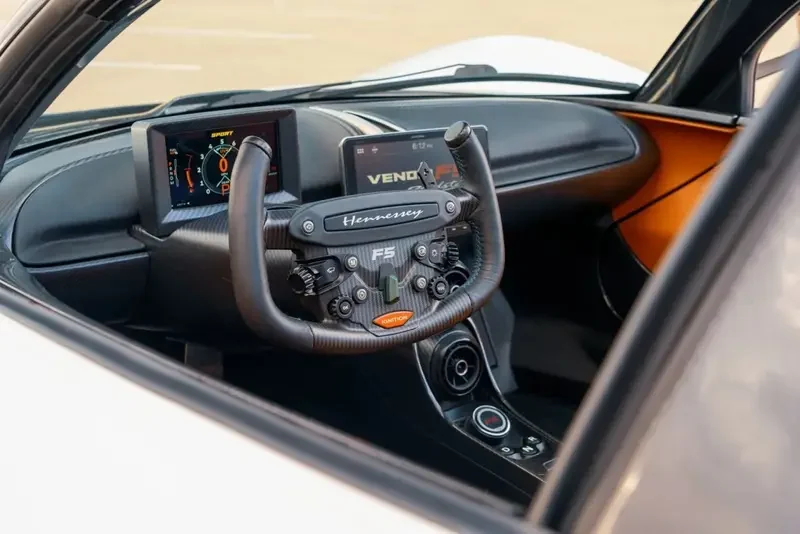
Spend time with the F5 Roadster, and you’ll uncover details that border on obsessive. The carbon-fiber roof panel stows in a compartment so precisely engineered that it clicks into place with the satisfaction of a bank vault locking.
The “Speed Key” system—a literal titanium fob—unlocks the car’s full power potential, but only after the onboard AI verifies the driver has completed a VR training module on a private track. Hennessey installs a hidden GPS-based “Texas Mode” that disables the 250-mph limiter when the car detects it’s on the company’s test runway.
Then there’s the “Aero Palette.” Unlike active wings that adjust automatically, the Roadster’s rear spoiler features seven manual settings, each tuned for specific scenarios—from “Sunday Cruise” (minimal drag) to “Apocalypse Now” (maximum downforce).
Owners receive a laminated cheat sheet, because memorizing aerodynamic configurations isn’t covered in most driving schools. The seats, upholstered in flame-retardant Alcantara, contain cooling channels that circulate chilled air from the AC system, a necessity when cabin temps can hit 120°F during hard driving.
The Politics of Speed
In an era where governments wage war on high-performance cars, the F5 Roadster is a political statement. It’s too loud for Europe’s noise regulations, too thirsty for California’s emissions standards, and too fast for any U.S. highway.
Yet Hennessey sells it as a “track-only” vehicle with a wink—the car comes with a fake glovebox manual titled “How to Explain This to Local Law Enforcement.” This loophole artistry mirrors the brand’s ethos: speed is a right, not a privilege.
Why It Matters
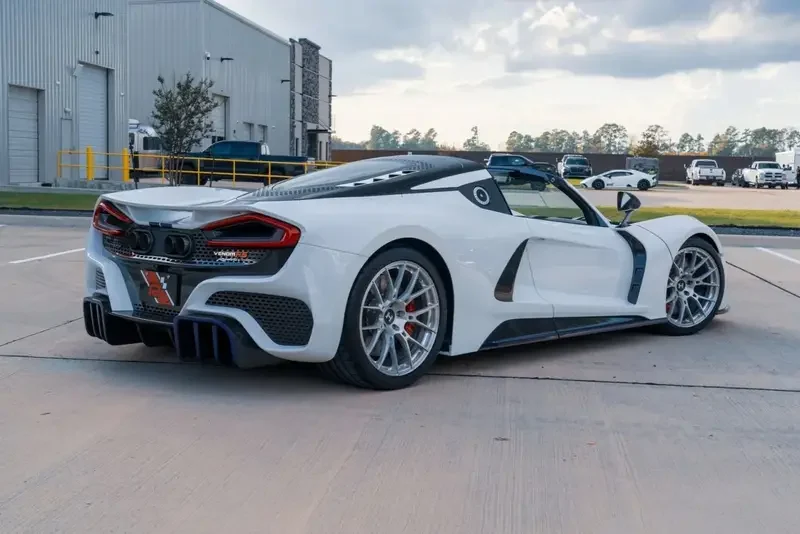
The Venom F5 Roadster isn’t just about numbers; it’s about preserving the theater of driving. At a time when EVs dominate headlines with silent acceleration, this car offers a sensory overload—the smell of burning race fuel, the vibration of unbridled horsepower, the terror of a rear end that steps out at 150 mph. It’s the last gasp of internal combustion, a $2.8 million time capsule for those who believe driving should hurt a little.
Practical Takeaways for the Insane
- The Roadster’s “Ludicrous Delivery” option includes a day at Hennessey’s Texas facility learning how not to die in it.
- Residual values are a gamble—only 12 will exist, but their legality on future roads is dubious.
- The trunk fits one (1) overnight bag, because priorities.
In the end, the F5 Roadster is less a car and more a manifesto: some boundaries exist to be broken, even if it costs a fortune—or your sanity—to do so.

 Zakirin