 Zakirin
Bugatti Mistral: An Epilogue to the Legendary W16 Engine Era
In the ever-evolving world of automotive engineering, there are a few brands that are renowned not just for their performance or luxury, but also for their heritage and commitment to engineering excellence. Bugatti, a name synonymous with speed, innovation, and unparalleled luxury, has once again made history with the launch of the Mistral, its latest model that not only stands as a pride for the French manufacturer but also marks the end of an era for the legendary W16 engine. Inspired by the strong Mediterranean winds that bring freshness, the Mistral is not just a fast open-top sports car; it is a symbol of the global automotive industry’s shift towards greener technology, while paying a final tribute to the internal combustion engine that has long been the backbone of Bugatti’s success.

The story of Bugatti began in 1909 when Ettore Bugatti, a brilliant Italian designer, founded the company in the town of Molsheim, Alsace, which was then part of the German Empire. Ettore’s vision was to create vehicles that combined art and engineering, a philosophy reflected in early models like the Type 13, which won its first Grand Prix race in 1921. However, Bugatti’s true success came with the Type 35, a racing car that dominated the tracks in the 1920s and 1930s, securing over 1,000 victories. Ettore’s engineering prowess was not limited to race cars; he also created the Type 41 Royale, a luxury car aimed at European nobility, equipped with a 12.7-liter straight-8 engine that remains one of the largest engines ever fitted in a passenger car.
After Ettore’s death in 1947, Bugatti faced challenging times. The company went through several ownership changes and nearly went bankrupt before being revived by the Volkswagen Group in 1998. Under the leadership of Ferdinand Piëch, Volkswagen invested millions of euros to bring the Bugatti legend back to life with the Veyron 16.4, launched in 2005. The Veyron was not just a car; it was a technological statement, featuring an 8.0-liter quad-turbo W16 engine producing 1,001 horsepower, capable of accelerating to 407 km/h, making it the fastest production car in the world at the time. The Veyron’s success was followed by the Chiron in 2016, which pushed the speed limit to 420 km/h while maintaining Bugatti’s design and engineering heritage.

However, in a world increasingly concerned about climate change, the fuel-guzzling, high-powered W16 engine began to be seen as a symbol of unsustainable luxury. This awareness led Bugatti to announce that the Mistral would be the last model to feature the iconic engine. Introduced in 2022, the Mistral is a two-seater roadster that combines design elements from the Chiron and Vision Gran Turismo models, but with modern touches that reflect Bugatti’s current identity. The name “Mistral” was chosen as a tribute to the strong winds of the Mediterranean, embodying the speed and elegance of this vehicle.
Developing the Mistral was no easy feat. Bugatti’s engineering team faced significant challenges in adapting the complex W16 engine into an open-top roadster framework, requiring structural reinforcements to maintain rigidity without a fixed roof. Additionally, the engine cooling system had to be redesigned to ensure optimal performance even in hot weather conditions, as the absence of a roof could affect ventilation. One of the most innovative features of the Mistral is its active aerodynamic system, which automatically adjusts based on speed, ensuring stability and balanced air pressure distribution.
In terms of performance, the Mistral does not disappoint. The 8.0-liter quad-turbo W16 engine produces 1,600 horsepower, making it one of the most powerful roadsters ever built. With a 0-100 km/h acceleration time of 2.4 seconds and a top speed exceeding 420 km/h, the Mistral not only inherits the DNA of the Veyron and Chiron but also sets a new standard for open-top sports cars. However, the Mistral’s brilliance lies not just in its numbers; it is a blend of cutting-edge technology and artistic design. Every line on the vehicle’s body is meticulously crafted to reduce air resistance, while the interior is adorned with luxurious materials such as Hermès leather and handcrafted carbon fiber accents.
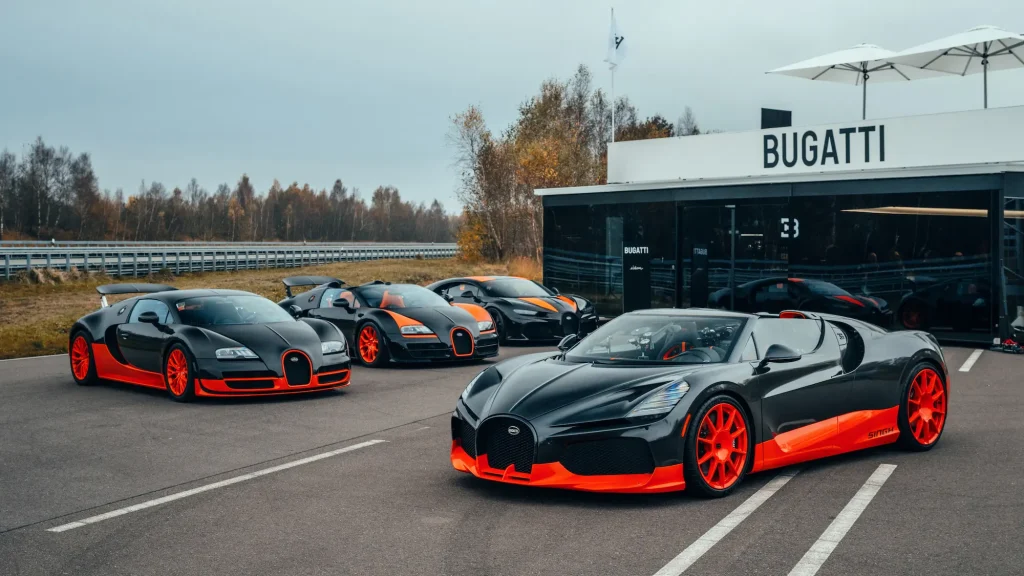
The history of the Mistral is also inseparable from Bugatti’s vision of creating vehicles that are not only fast but also collectible. Only 99 units of the Mistral will be produced, reflecting Bugatti’s tradition of limiting production to maintain exclusivity. Each unit can be customized through the “Sur Mesure” program, where buyers can choose unique colors, materials, and even embroidery patterns. This approach is not just a marketing strategy but a tribute to Ettore Bugatti’s legacy, who often created bespoke vehicles for elite clients such as royalty and industrialists.
Bugatti’s transition to the electric era has long been anticipated. In 2021, the company merged with Rimac Automobili, a high-performance electric car manufacturer from Croatia, to form Bugatti-Rimac. This partnership allows Bugatti to combine Rimac’s expertise in battery technology with their unmatched internal combustion engine engineering. The first model resulting from this collaboration, expected to launch in 2027, is rumored to feature a hybrid or fully electric powertrain. However, the Mistral will always be remembered as the last model to feature a pure W16 engine, an engine that not only redefined the limits of automotive engineering but also became a symbol of pride for high-performance car enthusiasts.

Delving into the history of the W16 engine, we cannot overlook how revolutionary this design was in the 2000s. The W16 engine was originally developed for the Veyron in response to Ferdinand Piëch’s challenge to create an 18-cylinder engine. Due to space constraints, the engineering team opted for a W16 configuration, combining two V8 engine blocks in a “W” arrangement. This decision not only saved space but also allowed the use of four turbochargers to boost power without sacrificing efficiency. Although criticized by many as overly complex, the W16 engine proved its durability through speed records and rigorous testing.
For the Mistral, the W16 engine underwent its final refinement. Upgraded turbochargers, a more precise fuel injection system, and ECU (Engine Control Unit) adjustments allowed this engine to achieve higher efficiency and power levels compared to previous models. However, what makes the Mistral special is how this engine is integrated into the roadster driving experience. Without a roof, the roar of the W16 engine becomes more vibrant, creating a captivating mechanical symphony for the driver and passengers.

In the context of the global automotive industry, the launch of the Mistral comes at a critical time. Growing awareness of climate change has forced many manufacturers to shift towards electric vehicles, with governments worldwide setting ambitious targets to reduce carbon emissions. Bugatti, as a niche brand producing high-performance vehicles, faces pressure to adapt without losing its identity. The Mistral, with its final W16 engine, is their answer to this dilemma—a statement that even as the internal combustion era may be ending, its legacy will be remembered through masterpieces like this.
Looking to the future, Bugatti has expressed its commitment to continue innovating with alternative technologies. Concepts like the Bolide, an experimental race car featuring a hybrid W16 engine, show that the company is not afraid to experiment. However, for loyal enthusiasts captivated by the sound and sensation of internal combustion engines, the Mistral will always be remembered as the end of an era. It is not just a car; it is a monument to engineering, a masterpiece that reminds us that in an increasingly digital and automated world, there is still room for pure mechanical beauty.
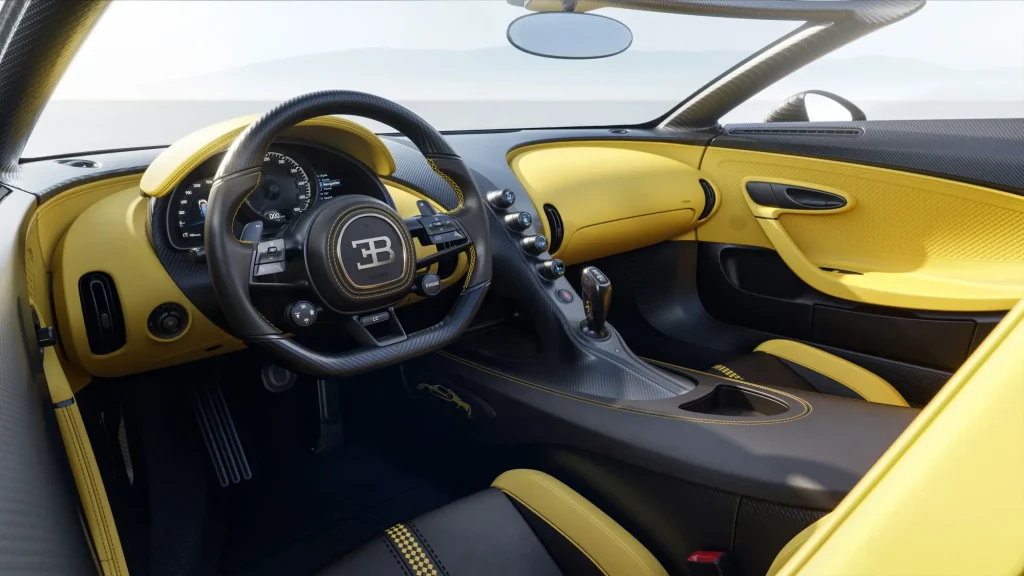
In conclusion, the story of the Bugatti Mistral is one of transition—from a glorious past to an uncertain future, from powerful engines to more sustainable technology. Yet, in this transition, the Mistral successfully captures the essence of Bugatti’s spirit: the courage to challenge limits, the desire to create beauty, and the commitment to remain relevant in a changing world. The W16 engine may fade into history, but its legacy will live on through every Mistral unit that glides down the road, carrying with it the Mistral wind that whispers the tale of a bygone era of greatness.
Need perfume? Buy erilavia