 Akmal Azhar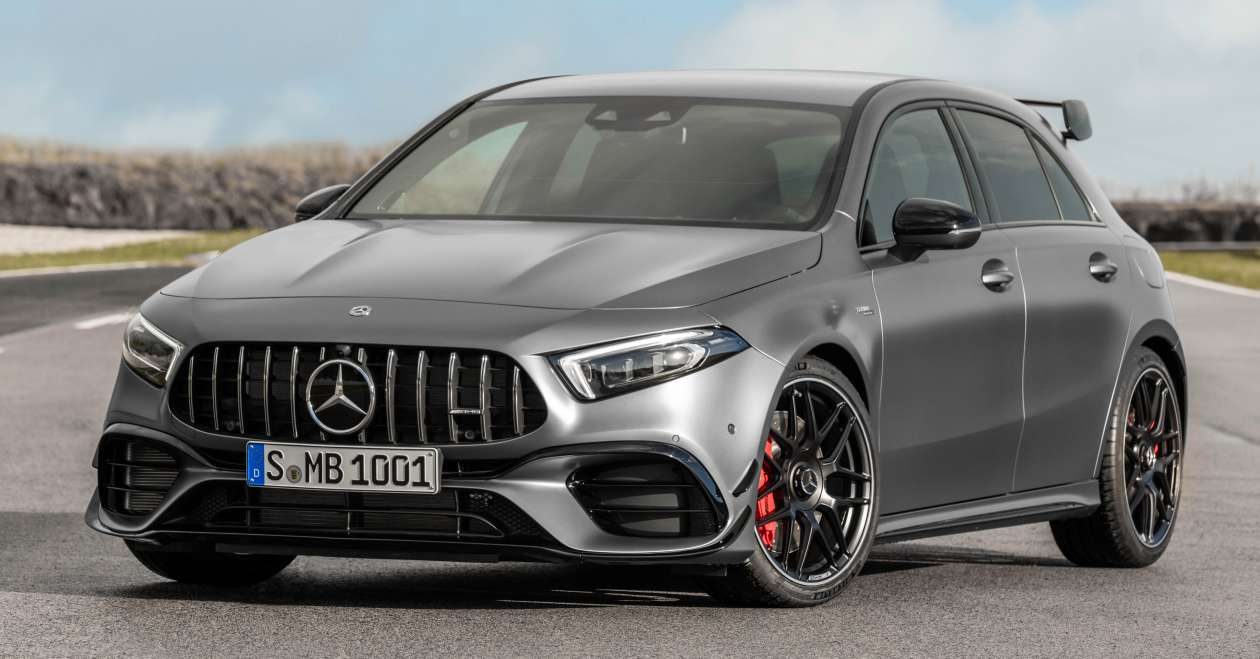
The automotive world stands at a crossroads as Mercedes-AMG prepares to pull the plug on its fire-breathing A45 S, the undisputed king of hot hatches.
This isn’t just another model discontinuation – it’s the sunsetting of a vehicle that redefined what we thought possible in a compact five-door package. With its impending departure, we’re not just losing a car; we’re witnessing the end of a philosophy that prioritized maximum performance in minimum dimensions.
The Birth of a Legend
When the first-generation A45 AMG burst onto the scene in 2013, it shattered expectations. The idea that a 2.0-liter four-cylinder engine could reliably produce 355 horsepower seemed ludicrous at the time. Mercedes-AMG didn’t just create a hot hatch – they created a benchmark that forced every competitor back to the drawing board.
The automotive press was stunned, rivals were scrambling, and enthusiasts were ecstatic. This was no ordinary hot hatch; this was an AMG first, hatchback second.
Engineering Madness: The M139 Powerplant
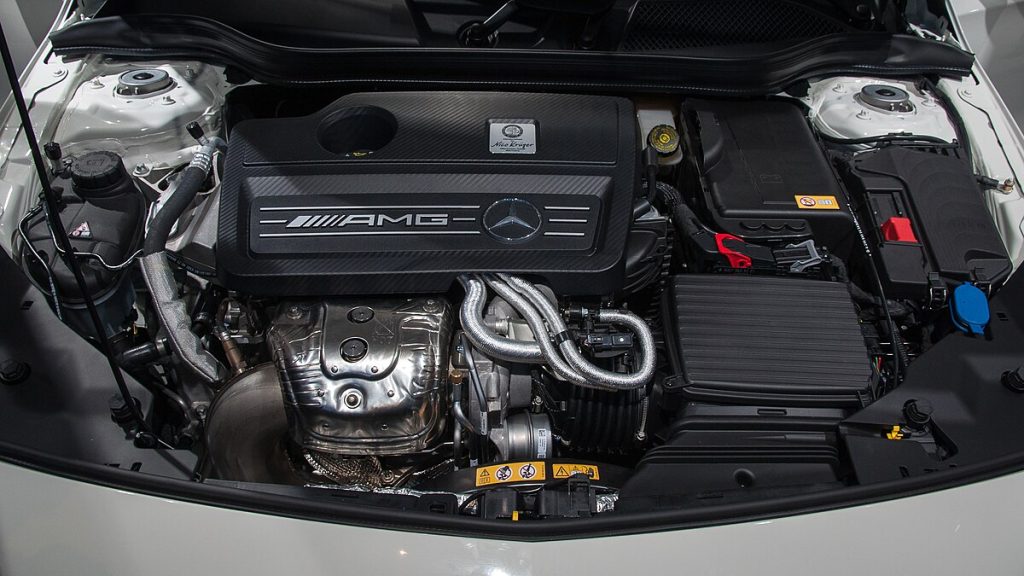
At the heart of the A45 S’ dominance lies its technological tour de force – the M139 engine. This 2.0-liter turbocharged four-cylinder isn’t just powerful; it’s a masterpiece of internal combustion engineering. The numbers alone boggle the mind: 421 horsepower translates to an astonishing 210.5 horsepower per liter, making it the most power-dense production engine in the world when it debuted.
The engineering solutions are even more impressive – a twin-scroll turbocharger mounted at the firewall for optimal weight distribution, an air-to-water intercooler integrated into the intake manifold, and a plasma-coated cylinder lining that reduces friction while improving durability. This isn’t an engine that was tuned for power; it was engineered from the ground up to break every convention in the rulebook.
More Than Just Straight-Line Speed
What truly set the A45 S apart from its competitors wasn’t just its staggering power figures, but how that power was deployed. The AMG Performance 4MATIC+ all-wheel-drive system represents one of the most sophisticated traction systems ever fitted to a hot hatch. Unlike conventional systems that simply shuffle power front to rear, the A45 S could vary torque distribution not just between axles but between individual rear wheels.
The result? A hatchback that could drift on demand when set to Drift Mode, yet remain impeccably composed during daily driving. The suspension setup was equally impressive, featuring a sophisticated multi-link rear axle with adaptive damping that could transform from comfortable commuter to track weapon at the touch of a button.
Why Mercedes-AMG is Walking Away
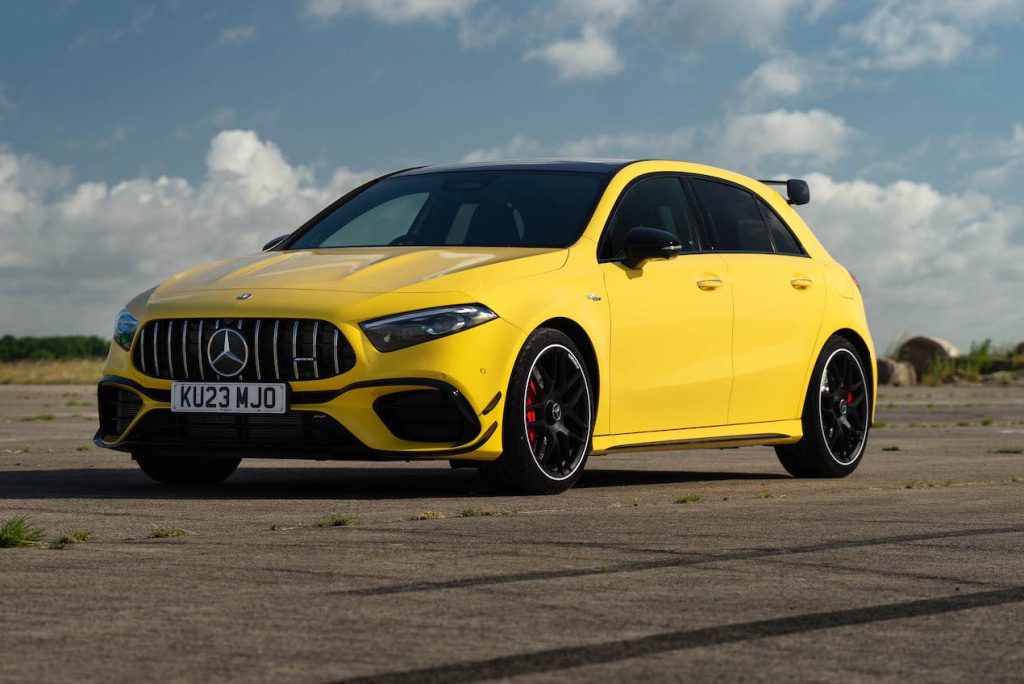
The decision to discontinue the A45 S reflects broader industry shifts that are reshaping performance motoring. Stringent Euro 7 emissions regulations present significant challenges for high-output, small-displacement engines like the M139.
The engineering resources required to keep such a specialized powerplant compliant are becoming prohibitively expensive, especially when Mercedes is committing billions to its electric vehicle transition.
Market trends have also played a role – the once-thriving hot hatch segment has been steadily eroded by the rise of high-performance SUVs like AMG’s own GLA 45. Even among enthusiasts, the appetite for compact performance cars appears to be waning as electrification changes what performance means.
The Cultural Impact of a Performance Icon

Beyond its technical achievements, the A45 S represented something more profound – it was the ultimate expression of the hot hatch philosophy taken to its logical extreme. In an era where cars keep growing larger and heavier, the A45 S proved that extreme performance didn’t require massive dimensions. It became a favorite among driving enthusiasts who wanted supercar-beating acceleration in a package that could actually be used every day.
The aftermarket community embraced it, with tuning houses extracting over 500 horsepower from the M139 with relative ease. On social media, the A45 S developed a cult following, with owners proudly sharing their track day exploits and drag race victories against far more expensive machinery.
What This Means for the Future of Hot Hatches
The discontinuation of the A45 S raises existential questions about the future of performance hatchbacks. While models like the Honda Civic Type R and Volkswagen Golf R continue, they represent an increasingly niche segment.
The industry’s shift toward electrification presents both challenges and opportunities – while electric powertrains could theoretically create even more powerful hot hatches, the added weight of batteries fundamentally changes their character.
Some manufacturers are exploring hybrid solutions, but none have yet matched the pure, unfiltered intensity that the A45 S delivered. As we move toward an electrified future, the A45 S may be remembered as the high-water mark of traditional hot hatch development – a vehicle that took the concept about as far as it could possibly go.
The Last of Its Kind
As production winds down, the A45 S takes with it a certain philosophy of performance that may never return. In an age where acceleration is becoming commoditized by electric powertrains, the A45 S reminds us of the joy of mechanical complexity – the whoosh of the turbo, the crackle of the exhaust on overrun, the satisfaction of perfectly executing a heel-toe downshift.
It represents the culmination of decades of hot hatch evolution, a vehicle that could embarrass supercars one moment and carry your groceries the next. For those who understand what made it special, the A45 S wasn’t just another performance car – it was perhaps the last great analog hot hatch in a rapidly digitizing automotive landscape. Its departure marks not just the end of a model line, but the closing of a chapter in performance car history.

 Zakirin