 Zakirin
If there is one venue on earth where a brand can rise from the ashes of bankruptcy to immediate, breathless applause, it is The Quail, A Motorsports Gathering. Amidst the manicured lawns of Monterey Car Week 2026, the automotive world witnessed the resurrection of an old, theatrical friend. Spyker, the boutique Dutch automaker famous for its aviation-inspired designs and tumultuous financial history, pulled the covers off its latest creation: the C8 Preliator XXV Coupé.
Limited to just 25 examples to celebrate the 25th anniversary of the modern Spyker brand, the new Preliator is an 800-horsepower, manual-only ode to analog craftsmanship. It is arguably one of the most stunning objects to debut in California this year. Yet, as founder Victor Muller proudly detailed the car’s hand-hammered aluminum body and exposed gear linkage, a profound realization began to ripple through the assembled journalists and collectors. For two decades, Spyker’s greatest flaw was its inability to become a mainstream manufacturer. With the XXV, the company isn’t trying to fix that flaw—it has weaponized it, deliberately turning its back on the very concept of being a “real” car company.
Aviation Artistry in Aluminum and Rose Gold

To look at the C8 Preliator XXV is to be transported to an alternate timeline where the jet age never fully replaced the romance of early aviation. While Spyker claims the XXV was conceived from a “clean sheet of paper,” its silhouette undeniably shares DNA with the 2016 C8 Preliator. However, the detailing has been radically elevated.
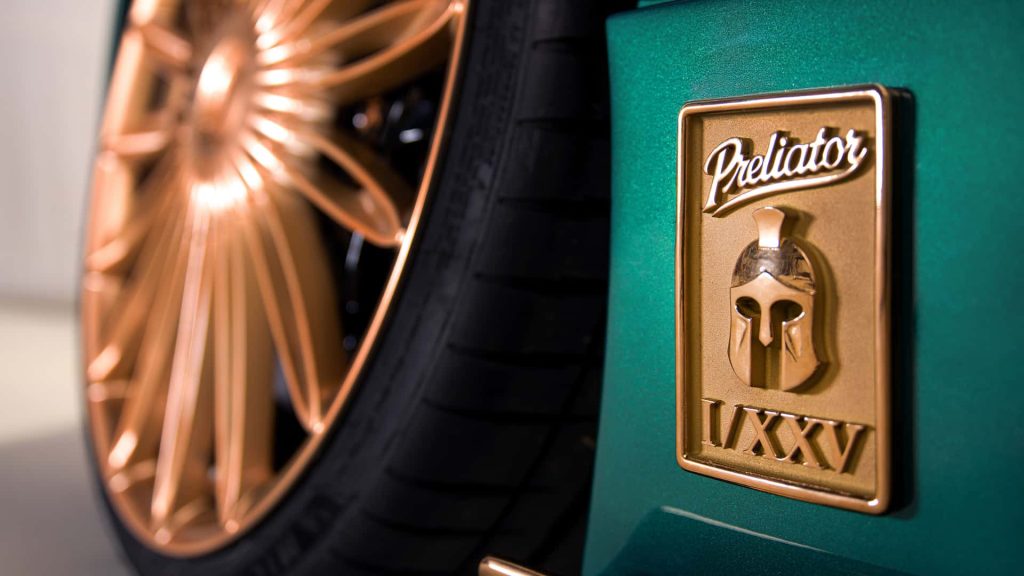
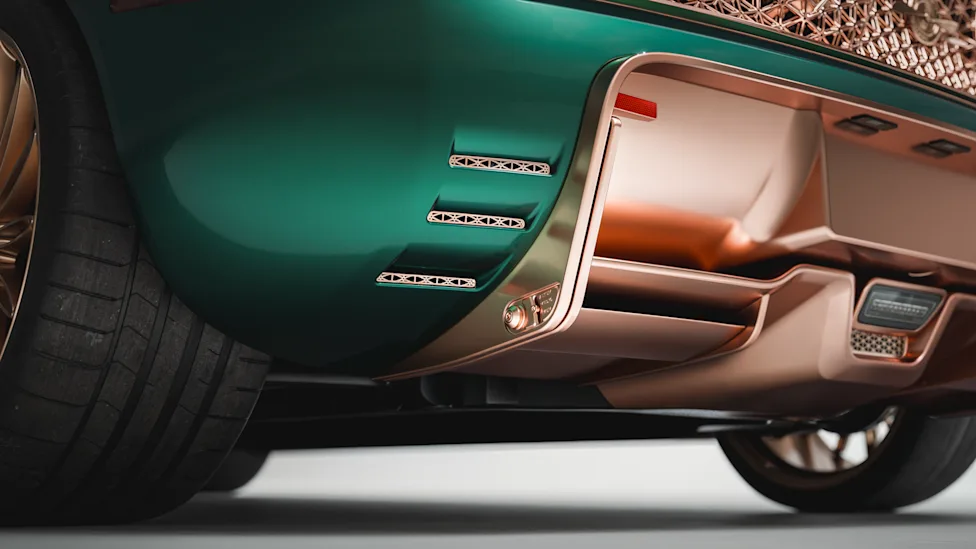
The launch car was presented in a bespoke “Quail Green” paint embedded with rose-gold metal flakes, creating an astonishing depth under the Monterey sun.This was offset by gleaming rose-gold brightwork across the exterior, most notably on the massive turbofan-style wheels, side vents, and mirror caps.
Every vent and duct tells a story. The front bumper and rear fenders feature aggressive NACA ducts carved directly into the aluminum, while the taillights are styled to mimic fighter-jet afterburners.Perhaps the most dramatic new visual signature is the rear tail fin, integrating a roof scoop that feeds fresh air directly into the engine bay—a deliberate homage to the 1919 Spyker C1 Aerocoque biplane-inspired racer.
The Analog Sanctuary
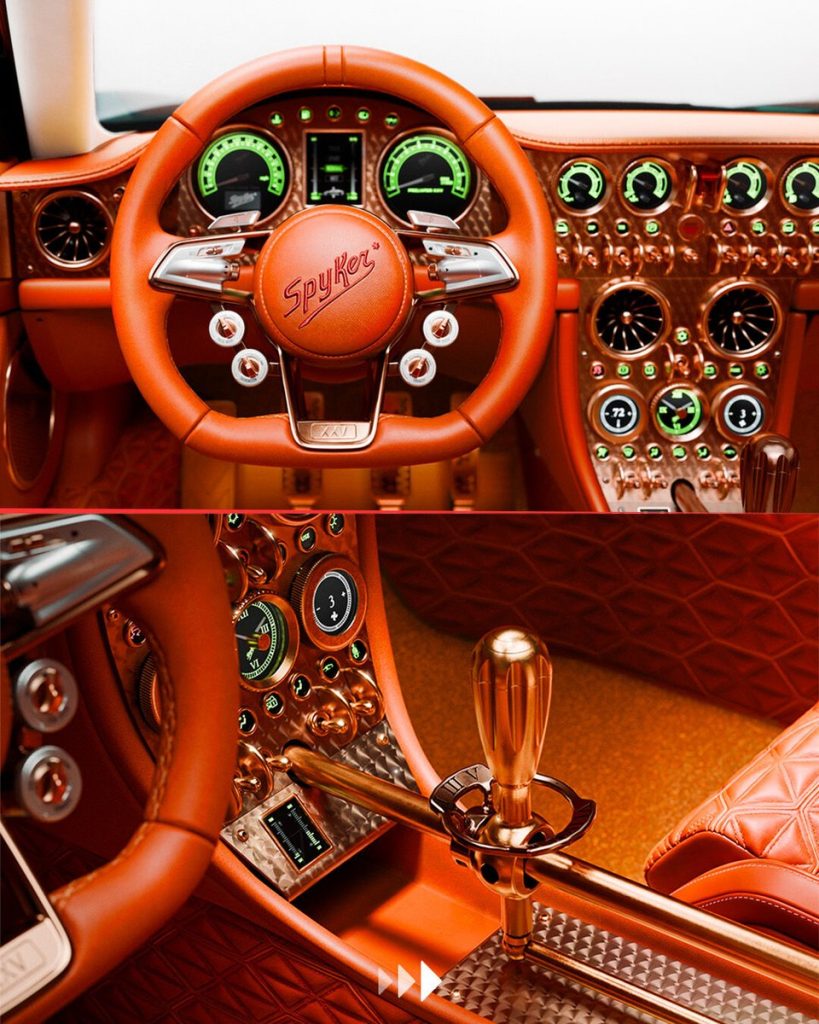
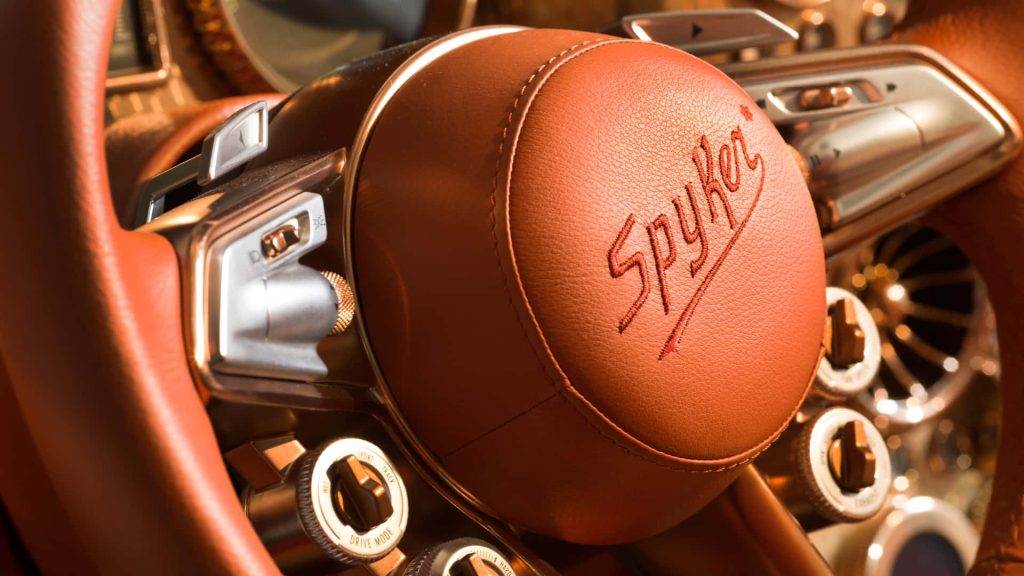
Open the theatrical dihedral doors, and you are greeted by what might be the most defiant interior of 2026. In an era where even track-focused hypercars are dominated by massive touchscreens and capacitive haptic feedback, the Spyker C8 Preliator XXV is a sanctuary of analog mechanisms.
There is not a single infotainment screen to be found on the dashboard.Instead, the fascia is a massive slab of turned aluminum housing a sequence of gorgeous, pale-green glowing analog dials. The switchgear consists of heavy, mechanical toggle switches that offer a deeply satisfying tactile click. The cabin is swathed in Tuscan Saddle brown leather featuring a large triangular quilt pattern, color-matched to the intricate lattice mesh covering the pedals and speaker grilles.
The centerpiece, however, remains a Spyker hallmark: the exposed manual gear linkage. Running through the center tunnel, the highly polished rod connects a rose-gold-bezeled shift lever to the transmission, allowing occupants to physically watch the mechanical action of every gear change.
An Audi Heart Beating at 800 Horsepower
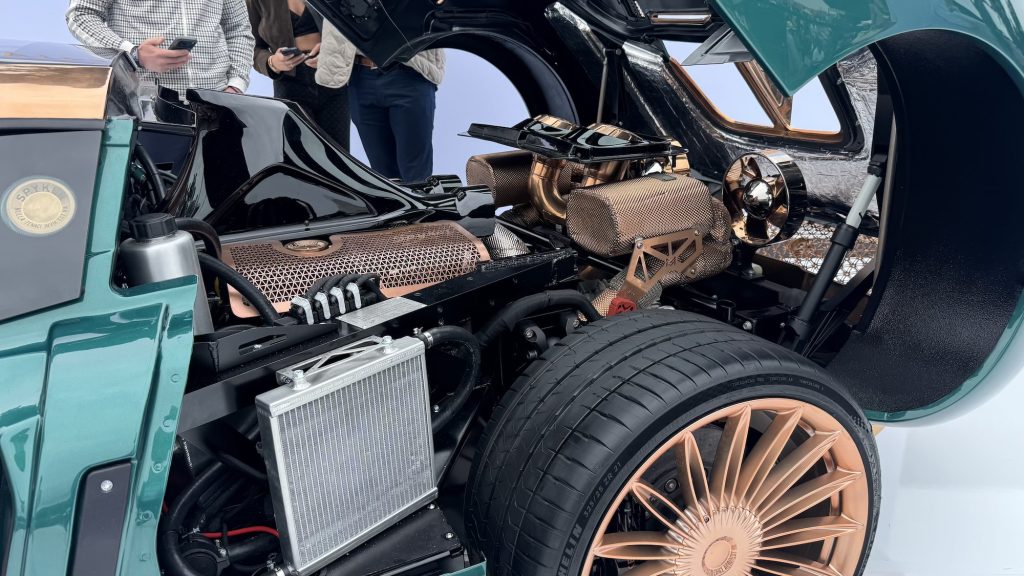
Underneath the hand-shaped aluminum bodywork lies a serious piece of modern German engineering. Spyker has partnered with Audi to supply a 4.0-liter twin-turbocharged V8 engine—the same fundamental architecture found in the RS 6 and R8—which has been heavily breathed upon to produce 789 horsepower (approximately 800 pk) and 737 lb-ft of torque.
This represents a massive leap in performance over past Spyker models. Weighing in at just 3,147 lbs (1,427 kg), the power-to-weight ratio is staggering.The sprint from 0 to 100 km/h (62 mph) is dispatched in a claimed 2.9 seconds, with a top speed exceeding 350 km/h (217 mph).
Crucially, this immense power is sent to the rear wheels exclusively through a proper six-speed manual gearbox. As Muller bluntly stated during the reveal, there are no paddles, no automatic rev-matching software, and no dual-clutch option. “We deliberately chose a real manual transmission, not an automated imitation,” he noted.
The “But…”: The Economics of Refusing to Scale

This is where the true narrative of the Preliator XXV emerges, and it fundamentally differs from standard supercar launch rhetoric.
Historically, Spyker’s failures were never failures of design or passion; they were failures of scale. After its revival in 1999, the company repeatedly tried to become a mainstream boutique automaker. It chased production volumes it could not afford to sustain, culminating in a disastrously ambitious purchase of Saab in 2010 that ultimately dragged Spyker into bankruptcy.The company dreamed in coachbuilt aluminum, but drowned in the financial realities of running an actual production line.
The C8 Preliator XXV represents a total inversion of that logic. By strictly limiting production to just 25 units and reportedly requiring over 2,100 hours of hand-work per car, Spyker has abandoned the illusion of being a scalable car company. They are no longer selling transportation or attempting to compete with Ferrari’s balance sheet. They are selling mechanical art to 25 specific people.
Critics have pointed out the realities of this hyper-boutique approach. Automotive journalists peering closely at the Monterey show car noted that the interior wasn’t entirely finished—missing lower dash panels and A-pillar trim—corroborating reports that the vehicle was rushed from sketch to a body-in-white in just a few months, allegedly fueled by a new, mysterious crypto-billionaire investor.The chassis and design, despite claims of being “clean sheet,” lean heavily on the architecture of the stillborn 2016 Preliator.
But in a strange way, that doesn’t matter. By refusing to industrialize, Spyker has turned its lifelong weakness—an inability to do volume—into its primary selling point.A car built this way could never be mass-produced, and for the ultra-wealthy seeking total exclusivity, that makes it infinitely more desirable.
The Verdict
Spyker has not confirmed an official price for the C8 Preliator XXV, but given the hand-commissioned nature of the 25 units, it is expected to command well over $1.5 million.
The Preliator XXV is a glorious, roaring contradiction. It uses modern twin-turbo power but refuses modern transmissions. It boasts hypercar speed but ignores digital interfaces entirely. But most importantly, it is a car built by a company that finally realizes its magic lies in staying incredibly small. If Victor Muller and his new investors can actually deliver these 25 magnificent machines to their owners, the XXV won’t just be a comeback—it will be proof that sometimes, the only way to survive the modern auto industry is to refuse to play by its rules.