 Zakirin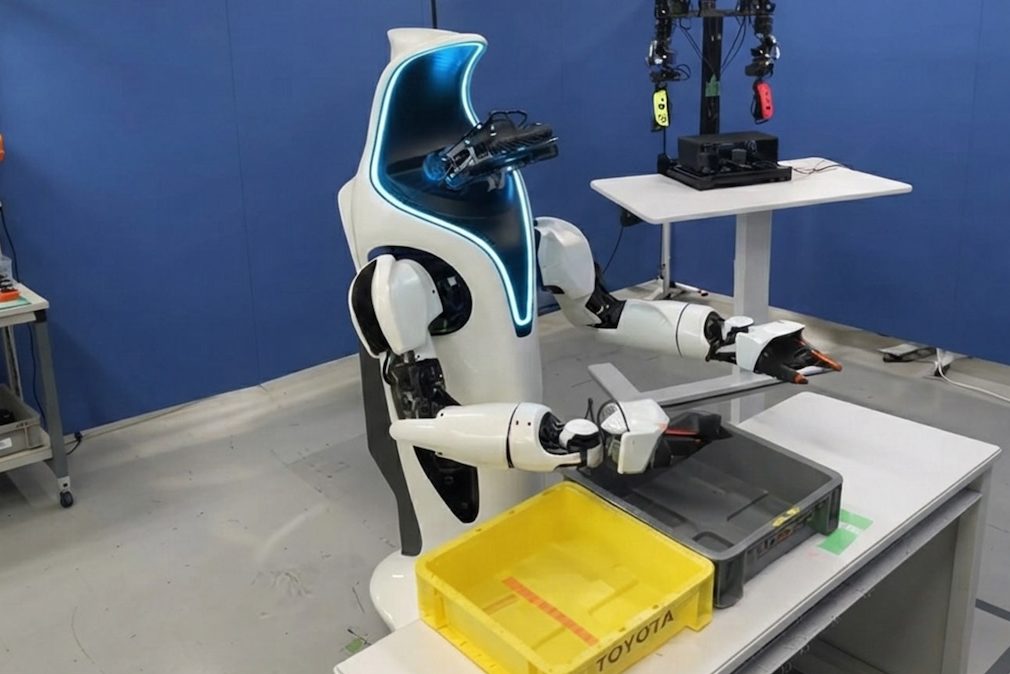
Toyota Motor Corporation has outlined an extensive manufacturing modernization program committing approximately ¥1 trillion (approx. RM30.0 billion) annually beginning in 2028, targeting the deployment of roughly 400,000 advanced industrial and collaborative humanoid robots across 60 vehicle assembly and supplier facilities globally.
- Toyota commits approximately ¥1 trillion (approx. RM30.0 billion) annually starting in 2028 to roll out 400,000 robots, dividing deployment across 150,000 internal factory units and 250,000 group-affiliated and supplier facilities.
- The automation initiative is led by “Eley,” a 50-kilogram wheeled humanoid robot equipped with dual-fingered grippers designed to autonomously learn fine assembly tasks through direct human demonstration.
- The system utilizes Large Behavior Models (LBMs) to digitize the manual techniques of 18,000 veteran “takumi” craftsmen into a closed-loop network where robots learn from workers and help train incoming personnel.
The automation blueprint represents one of the largest hardware and software overhauls in modern automotive manufacturing history. Rather than executing isolated pilot programs, Toyota aims to retrofit its global manufacturing footprint as facilities undergo scheduled mid-lifecycle tooling renewals. The strategy directly addresses impending industrial labour shortages in domestic and overseas production hubs while containing long-term manufacturing overheads.
| Program & Operational Metric | Toyota Global Factory Automation Blueprint |
| Projected Annual Expenditure | Approximately ¥1.0 trillion (approx. RM30.0 billion) |
| Implementation Timeline | Phased operational deployment commencing in 2028 |
| Total Global Fleet Target | Approximately 400,000 units (Humanoid and specialized industrial mix) |
| Direct Assembly Allocation | 150,000 units deployed across wholly owned Toyota assembly plants |
| Group & Supplier Allocation | 250,000 units across group affiliates and tier-one component suppliers |
| Global Facility Footprint | Approximately 60 vehicle and powertrain manufacturing complexes |
| Flagship Collaborative Unit | Eley (Embodied Learning Robot for Enhanced Yield) |
| Chassis & Mobility Form Factor | 50 kg mass; wheeled mobile base with corded or high-capacity battery supply |
| Manipulator Architecture | Dual articulated arms fitted with two-fingered compliant grippers |
| AI Architecture & Training | Large Behavior Models (LBMs) via Toyota Research Institute (TRI) |
| Primary Knowledge Base | Empirical data captured from 18,000 master assembly craftsmen (takumi) |
Pragmatic Humanoid Design: Wheeled Mobility Over Bipedalism
The technical flagship of Toyota’s automation portfolio is Eley, an embodied collaborative robot designed around practical factory utility rather than cosmetic anthropomorphism. Weighing approximately 50 kilograms, Eley departs from the bipedal humanoid format favored by industry competitors in favor of a motorized wheeled base.
Toyota engineers selected wheeled mobility to maximize operational uptime, eliminate dynamic balancing issues on flat plant floors, and enable continuous power delivery through either high-capacity onboard batteries or overhead floor umbilical lines. Similarly, Eley foregoes complex five-digit robotic hands, utilizing robust two-fingered mechanical grippers capable of exerting high clamping precision while minimizing mechanical failure points.
Closed-Loop Skill Transfer and Capturing Takumi Craftsmanship
Rather than relying purely on simulated synthetic data, Eley learns complex assembly movements through direct observation. Human line workers wear specialized sensor-laden jigs calibrated to the robot’s physical gripper dimensions, executing tasks repeatedly while the robot’s machine vision cameras and spatial sensors record fine motor adjustments, applied pressure, and angle tolerances. In internal factory validation trials, Eley achieved near-perfect accuracy in complex material handling and folding within 1,500 supervised demonstration cycles over a two-week period.
The system is structured around Toyota’s proprietary Large Behavior Models (LBMs), developed in coordination with the Toyota Research Institute (TRI) using diffusion-based generative artificial intelligence. The primary goal is capturing the tacit procedural knowledge of Toyota’s 18,000 recognized takumi (master craftspeople), whose sensory intuition in stamping, panel alignment, and wiring harness routing has historically resisted standard mechanical programming.
Once digitized, this operational data is synchronized across Toyota’s global manufacturing footprint under an industrial framework dubbed “Factory Automation 3.0.” This shared architecture creates a closed-loop skill transfer process: seasoned workers train local robots, the network refines the operational parameters globally, and calibrated robots subsequently assist in training new human assembly technicians at regional production facilities.
Collaborative Deployment Over Wholesale Labour Displacement
Despite widespread industry concerns regarding robotics displacing manual assembly roles, executive leadership stressed that the deployment is calibrated around co-working environments. Toyota Executive Vice President Hiroki Nakajima noted that the objective is establishing an operational floor where robots and technicians coexist, reallocating repetitive physical strain, component lifting, and heavy material kitting to automated hardware while preserving human judgment for quality control and system optimization.
Toyota’s multi-tier approach will also incorporate external specialized hardware, including ongoing assessments of Agility Robotics’ bipedal Digit robot for specialized logistics tasks. The comprehensive rollout will formally commence across primary Japanese and North American vehicle plants in 2028 before expanding through affiliated supply chains internationally.