 Zakirin
If there was an overarching theme to Monterey Car Week in August 2026, it was a heavy, romantic nostalgia. The greens of Pebble Beach and the bustling stands of The Quail were dominated by analog revivals, coachbuilt tributes to the 1930s, and meticulous celebrations of vintage motorsport. The hypercar industry was busy looking backward. And then, there was the Czinger 21C Spyder.
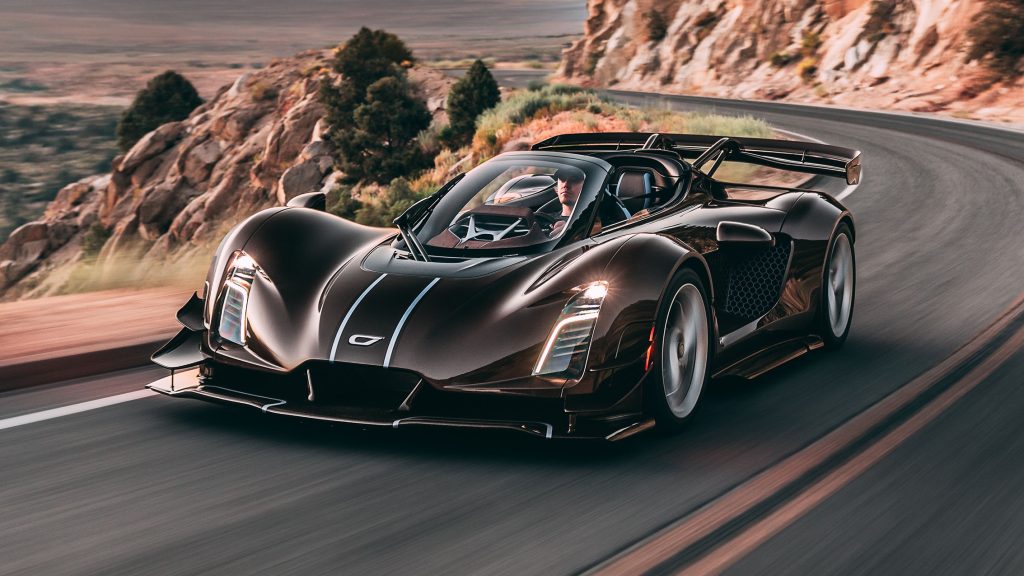
Unveiled by the Los Angeles-based boutique automaker just seven years after the company’s inception, the 21C Spyder arrived like an alien artifact dropped into a vintage car show.It boasts a roofless fighter-jet cockpit, a screaming 11,000-rpm hybrid V8, and 1,250 horsepower. It is, by every traditional metric, a staggering achievement in automotive performance. Yet, as the crowds swarmed its web-like, skeletal chassis components, a profound realization began to ripple through the engineering community. The 21C Spyder isn’t just a hypercar; it is a $2.75 million, 200-mph billboard proving that the traditional automotive factory is obsolete.
The Fighter Jet for the Road

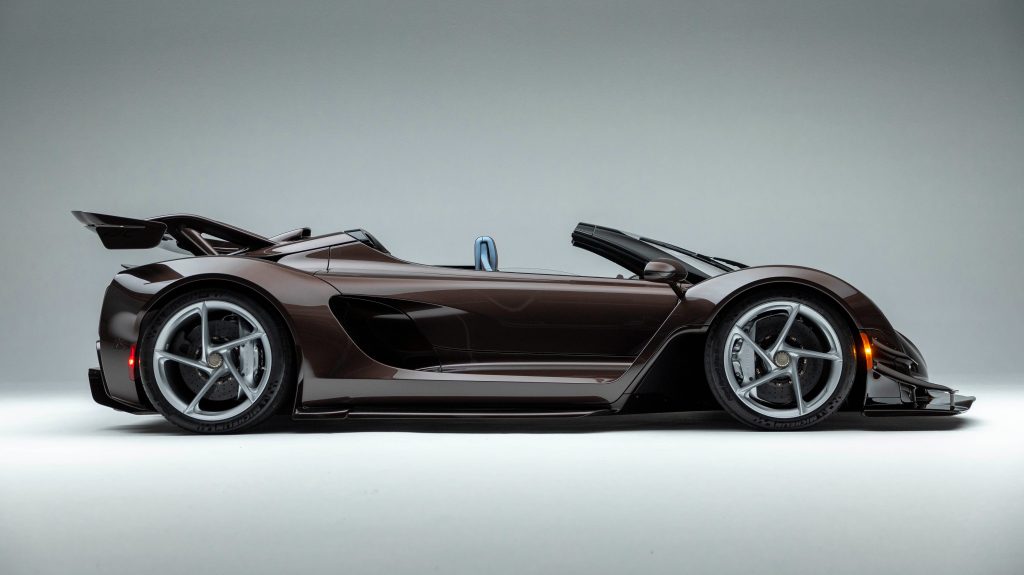
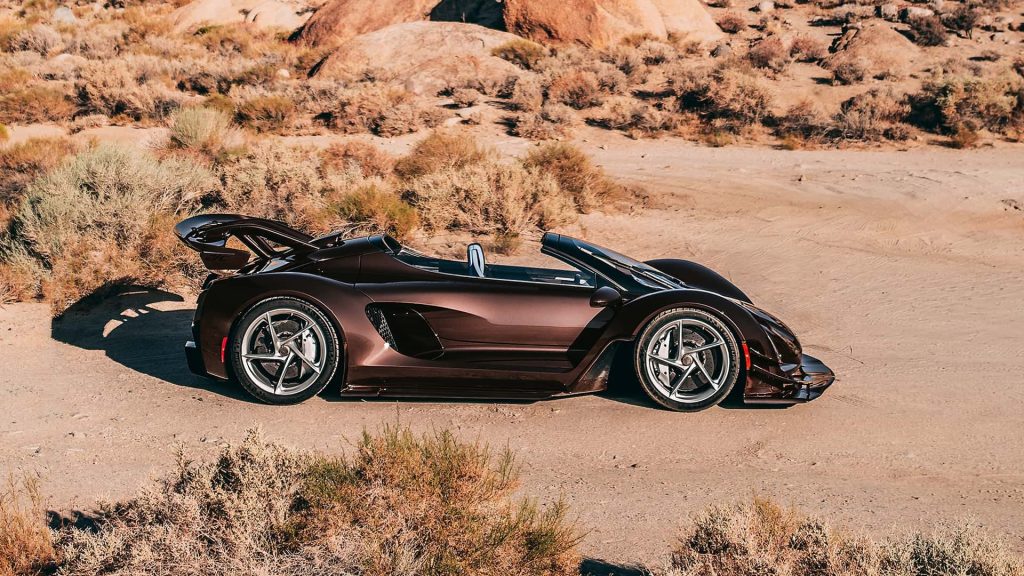
Even without its underlying manufacturing revolution, the 21C Spyder demands attention through its sheer audacity. Removing the roof from the record-setting 21C coupe was not simply a matter of slicing off carbon fiber. Czinger engineered the Spyder to deliver an unparalleled open-air sensory assault.
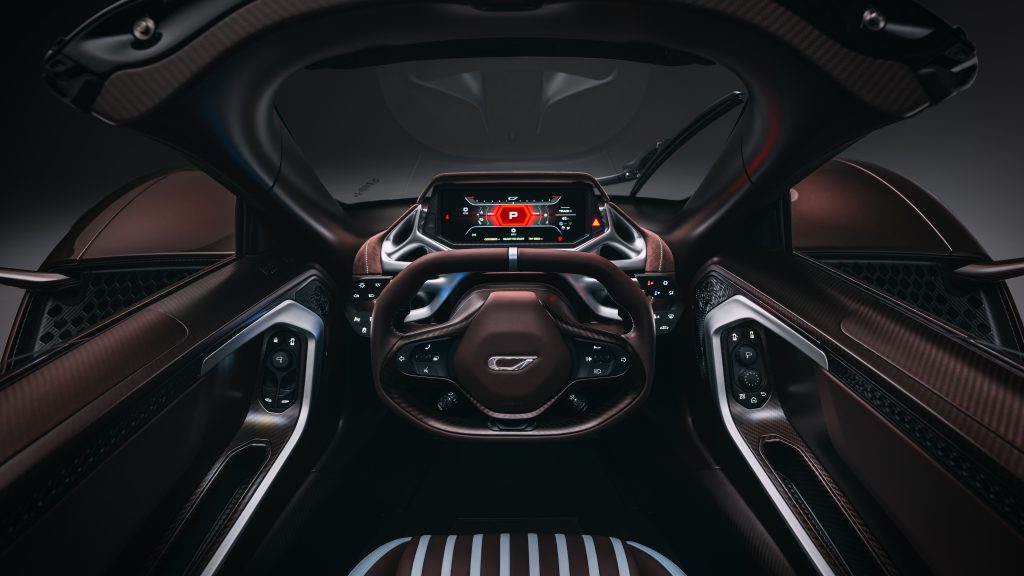
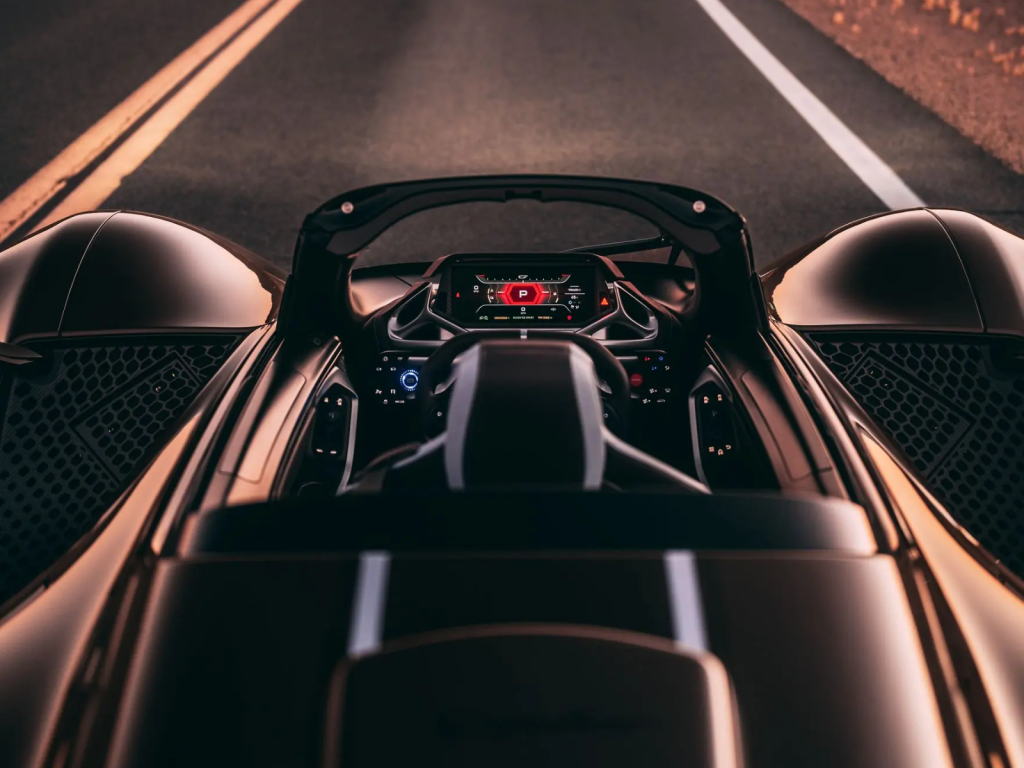
The defining characteristic of the 21C family remains its dramatic seating configuration. Rather than placing the driver and passenger side-by-side, which forces compromises in frontal aerodynamics, the 21C utilizes inline tandem seating.The driver sits dead center in the vehicle, while the passenger sits directly behind them with their legs straddling the driver’s seat—an arrangement some have affectionately dubbed a “human backpack”.
With the roof panel removed, this layout transforms the car into a road-going fighter jet. Czinger notes that without a canopy, the rush of air on either side of the central occupants creates a driving experience totally singular in the automotive world. To accommodate this open-top environment, Czinger introduced the “NeuralNode”. This central vehicle control system utilizes a striking exoskeletal form, built from additively manufactured metal, to consolidate HVAC, steering, and major controls into an ergonomic hub tailored specifically for top-down comfort.
11,000 RPM of Hybrid Fury
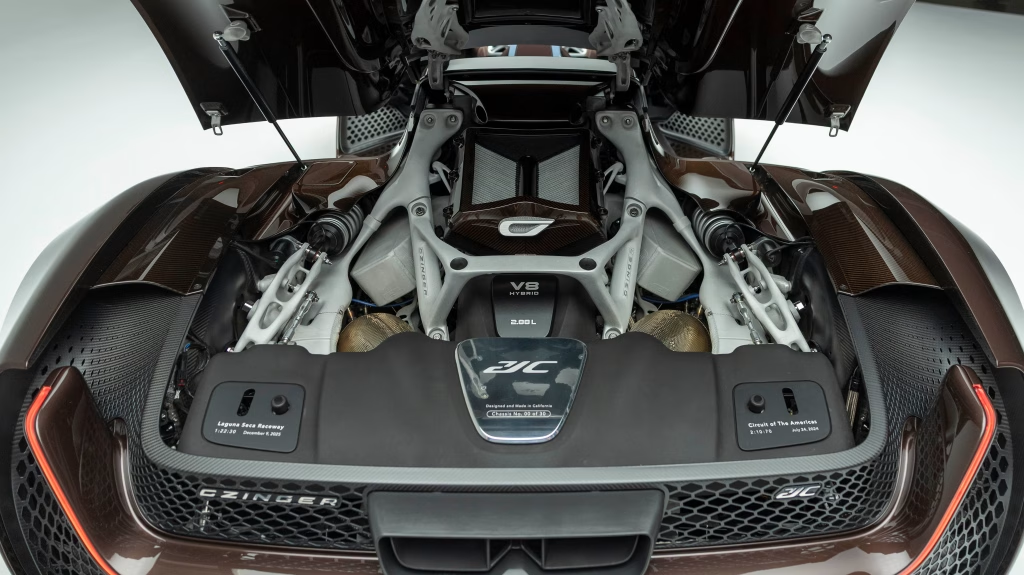
Sitting just inches behind the passenger’s head is one of the most power-dense internal combustion engines on the planet. Because the inline seating and aggressive aerodynamics left very little physical space, Czinger had to develop its own bespoke powertrain from scratch.
The result is a tiny 2.88-liter twin-turbocharged flat-plane crank V8.It weighs a mere 105 kg (231 lbs) but produces an astonishing 750 horsepower purely from combustion.That translates to 264 horsepower per liter—an absurd specific output for a road-legal car running on pump gas.Better yet, it revs to a stratospheric 11,000 rpm, flooding the open cabin with the shrieking induction noise of the roof-mounted intake.
But this is a hypercar of the 2020s, so combustion is only half the story. The V8 is paired with an 800-volt hybrid architecture featuring two permanent-magnet synchronous electric motors driving the front wheels, plus a third motor-generator unit connected to the crankshaft.Combined, the system produces 1,250 horsepower (with an optional upgrade to 1,350 hp available) and 691 lb-ft of torque.
The performance figures read like science fiction: 0 to 60 mph in 1.9 seconds, a standing quarter-mile in 8.7 seconds, and a top speed in excess of 205 mph. Despite losing its roof, the car’s aerodynamics remain brutally effective; the Spyder generates 3,267 pounds of downforce at 150 mph, making it one of the most aerodynamically aggressive open-top cars in history.
The “But…”: Algorithms, Lasers, and the Death of the Assembly Line
If you evaluate the 21C Spyder purely on its tandem seating and its 11,000-rpm V8, it is a masterpiece. But focusing on the speed misses the entire point of what Czinger brought to Monterey.
Underneath the hypercar skin lies a philosophy the company calls “BioLogic Engineering”. The 21C Spyder’s chassis is not made from traditional stamped steel, nor is it a conventional bonded carbon-fiber tub. Instead, its load-bearing structures are designed by artificial intelligence and built by 3D printers.
Czinger’s sister company, Divergent, has developed an additive manufacturing platform where an algorithm is given a set of physical constraints (e.g., “connect this suspension mount to this engine brace while saving as much weight as possible”). The AI then generates the optimal structure. Because it isn’t bound by human aesthetics or the limitations of traditional casting and welding, the computer generates shapes that look organic—like the webbed bones of an alien skeleton or the roots of a tree.Lasers then sinter powdered metal alloy, layer by microscopic layer, into these exact shapes.
The ultimate expression of this in the Spyder is a new component called the “BrakeNode”. In a traditional car, a suspension upright, a brake caliper, and hydraulic fluid lines are separate, heavy parts bolted together. The BrakeNode integrates all of these into a single, unified 3D-printed metal structure. It eliminates failure points, drastically reduces unsprung mass at the wheel, and is claimed to reduce stopping distances by up to 15 percent.
This brings us to the grand contradiction of the 21C Spyder: It is the ultimate driver’s car, built by a company whose ultimate goal isn’t really building cars.
Critics and industry analysts correctly point out that the 21C is essentially an advertisement. The true product is the Divergent Adaptive Production System (DAPS)—the robotic, AI-driven micro-factory that prints the car. By building the fastest, most extreme hypercar in the world, the Czinger brothers are providing indisputable, 200-mph proof-of-concept to global automakers and aerospace giants that 3D-printing complex structural nodes is not just viable, but vastly superior to traditional manufacturing.
The Verdict
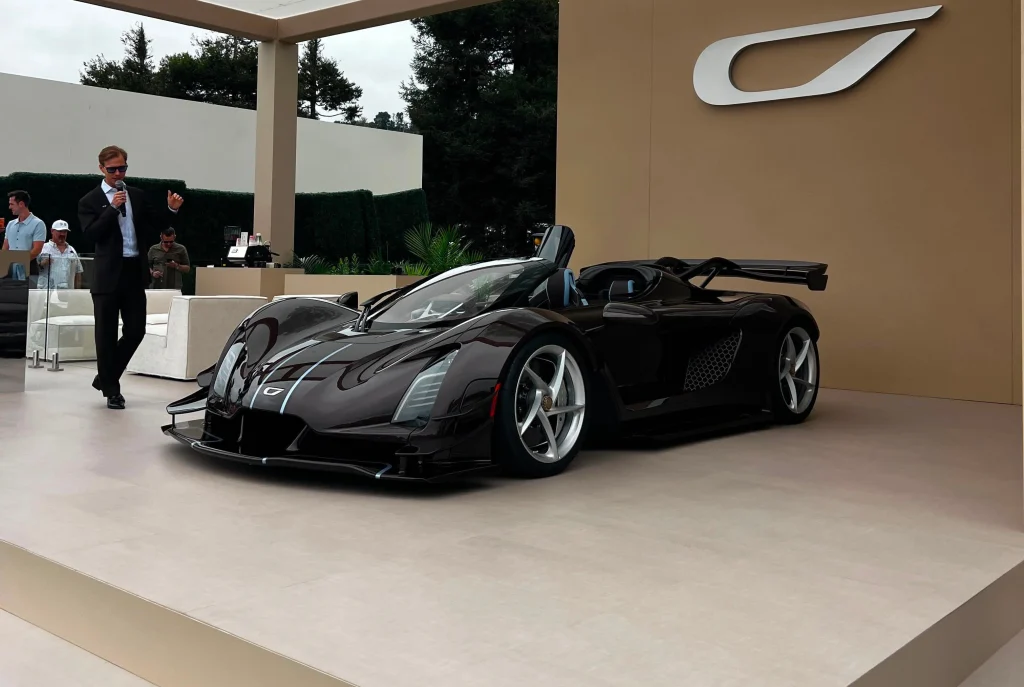
Limited to just 30 units globally and priced at an eye-watering $2.75 million, the Czinger 21C Spyder is destined to remain a unicorn.Every single car is fully homologated for road use in all 50 U.S. states and will be meticulously hand-assembled at the company’s Area 21 facility in Los Angeles.
While the rest of the automotive elite at Monterey Car Week celebrated the romance of the past, Czinger offered a violent, screaming look into the future. The 21C Spyder proves that the limits of performance have not yet been reached—we just needed to hand the design tools over to the algorithms to show us what was possible. It is a spectacular convertible hypercar, yes. But its true legacy will be the day it convinced the world that factories don’t need stamping presses anymore.