 Zakirin
The Koenigsegg Gemera stands as a monumental achievement in automotive engineering, blending hypercar performance with grand touring practicality in a way that challenges conventional definitions of high-performance vehicles. Unveiled as the world’s first Mega-GT, the Gemera reimagines what a car can be, merging cutting-edge technology with a focus on sustainability, innovation, and everyday usability. At its core lies a revolutionary powertrain that defies traditional norms, combining a compact yet potent internal combustion engine with three electric motors to deliver a staggering 1,700 horsepower and 3,500 Nm of torque, figures that place it firmly in the realm of hypercar exclusivity while maintaining a surprising degree of environmental consciousness. What truly sets the Gemera apart, however, is not just its eye-watering performance statistics but the manner in which Koenigsegg has reengineered fundamental automotive systems, most notably through the complete elimination of the traditional differential, a component long considered essential in power delivery and handling dynamics. This bold decision reflects the company’s philosophy of questioning established automotive conventions, a mindset that has become synonymous with the Swedish marque’s approach to pushing technological boundaries.

The absence of a differential in the Gemera’s drivetrain represents a paradigm shift in how power is distributed to the wheels, achieved through Koenigsegg’s innovative Direct Drive system combined with sophisticated torque vectoring capabilities. Unlike conventional all-wheel-drive systems that rely on mechanical differentials to manage wheel speed differences during cornering, the Gemera employs individual electric motors on each rear wheel, working in concert with a third electric motor integrated with the internal combustion engine at the front axle. This arrangement allows for infinitely variable torque distribution between the rear wheels without the need for physical differential gears, enabling precise control over power delivery that adapts instantaneously to driving conditions. The front axle’s combination of a 2.0-liter twin-turbocharged three-cylinder engine – dubbed the Tiny Friendly Giant (TFG) – and an electric motor creates a hybrid powertrain that can operate in pure electric mode, pure combustion mode, or any combination of the two, while the rear electric motors independently manage their respective wheels. This radical approach not only reduces mechanical complexity and weight but also enhances reliability and packaging efficiency, freeing up space that would traditionally be occupied by differential components and associated drivetrain elements.
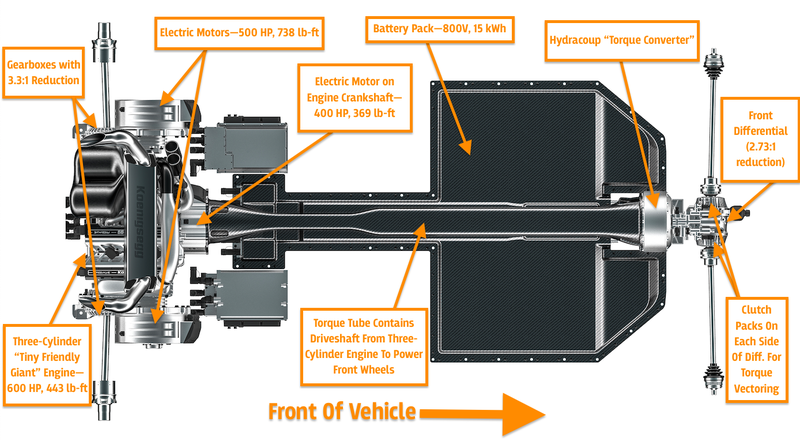
Koenigsegg’s decision to eliminate the differential stems from a holistic reimagining of vehicle dynamics control, leveraging the instantaneous torque response and precise controllability of electric motors to achieve superior handling characteristics. Each rear-wheel electric motor can vary its output thousands of times per second, effectively creating a virtual differential through software algorithms that manage torque distribution based on steering angle, throttle input, yaw rate, and wheel speed data. This level of control enables torque vectoring capabilities far beyond what mechanical systems can achieve, allowing the Gemera to precisely modulate power delivery to individual wheels during cornering, acceleration, and braking. The system can induce subtle differences in wheel speed to enhance stability during high-speed maneuvers or create dramatic torque vectoring effects for aggressive cornering, all while maintaining seamless power delivery. This electronic torque vectoring system works in harmony with the vehicle’s stability control and traction management systems, creating a dynamic platform that adapts to driver inputs and road conditions with unprecedented responsiveness.

Beyond its revolutionary drivetrain, the Gemera showcases Koenigsegg’s commitment to pushing multiple technological frontiers simultaneously. The TFG engine itself represents a marvel of combustion engineering, producing 600 horsepower from just three cylinders through a combination of advanced turbocharging, hybrid assist technology, and innovative combustion chamber design. Despite its compact dimensions, the engine features a unique Freevalve system that replaces traditional camshafts with pneumatic-hydraulic-electronic actuators, allowing for infinitely variable valve timing and lift control. This technology, developed through Koenigsegg’s sister company Freevalve, enables optimal engine performance across the entire rev range while significantly reducing emissions and improving fuel efficiency. The TFG engine’s ability to run on renewable fuels such as ethanol or carbon-neutral synthetic gasoline further underscores Koenigsegg’s environmental considerations, positioning the Gemera as a hypercar that addresses both performance and sustainability imperatives.
The Gemera’s electric propulsion system deserves equal attention, with its three electric motors contributing 1,100 horsepower to the combined output. The rear axle’s pair of electric motors each produce 500 horsepower, while the front electric motor adds another 400 horsepower, creating a torque-rich electric propulsion system that can propel the Mega-GT to 100 km/h in 1.9 seconds even without assistance from the combustion engine. This electric infrastructure is supported by a 16.6 kWh battery pack that provides up to 50 kilometers of pure electric range, designed to accommodate daily commuting needs while maintaining the ability to unleash full hybrid power for track days or high-performance driving. The battery system employs 800V architecture, enabling ultra-fast charging capabilities that can replenish 80% of the battery’s capacity in just 20 minutes using appropriate charging infrastructure. This combination of explosive performance and practical electric range creates a hypercar that genuinely bridges the gap between extreme performance and daily usability, challenging the notion that high-strung exotic cars must be relegated to weekend use only.
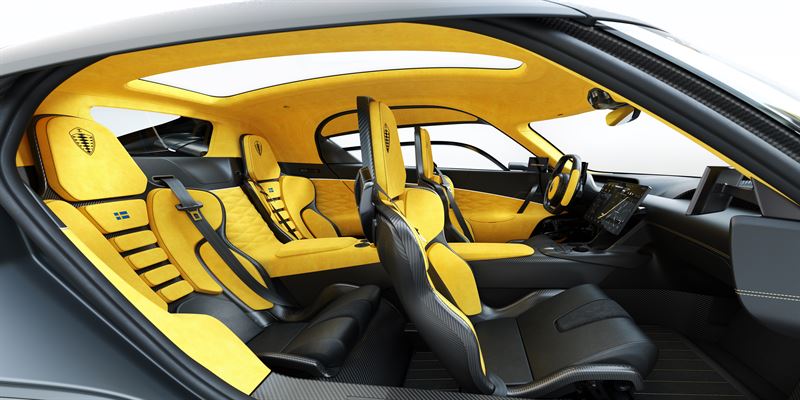
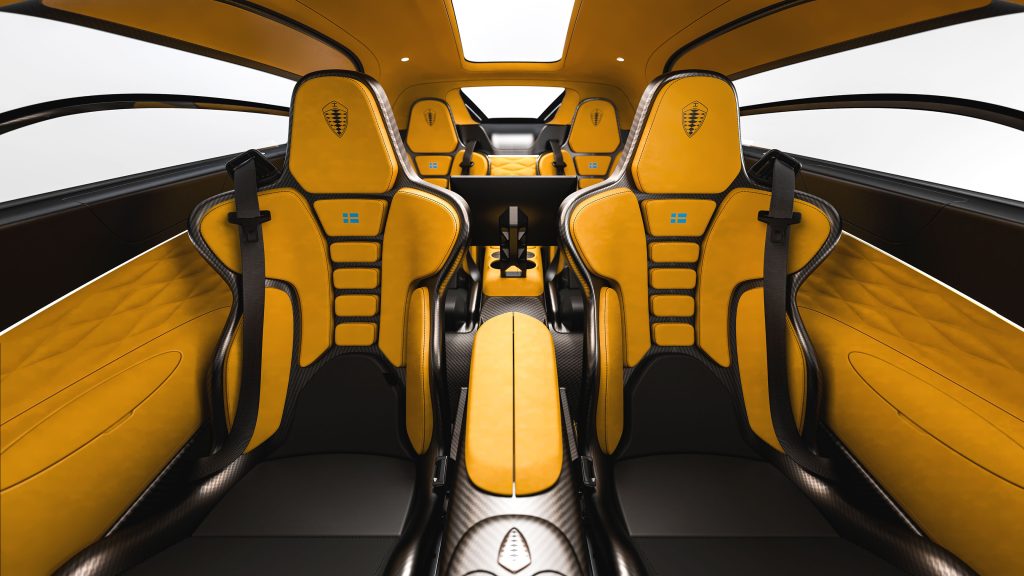
Koenigsegg’s engineering prowess extends beyond the powertrain to every aspect of the Gemera’s design. The carbon fiber monocoque chassis represents the latest evolution of the company’s expertise in lightweight construction, achieving exceptional rigidity while maintaining a relatively spacious interior cabin. The Gemera’s designation as a Mega-GT becomes apparent in its interior packaging, offering seating for four adults with generous legroom and storage space – a remarkable feat in the hypercar segment where two-seater configurations are the norm. The cabin combines luxury appointments with driver-focused technology, featuring advanced infotainment systems, customizable digital displays, and premium materials that maintain Koenigsegg’s reputation for meticulous craftsmanship. Practical elements like front and rear cup holders, wireless charging pads, and ample storage compartments coexist with race-inspired elements like carbon fiber bucket seats and a fighter jet-style central control interface, creating a unique blend of comfort and performance orientation.
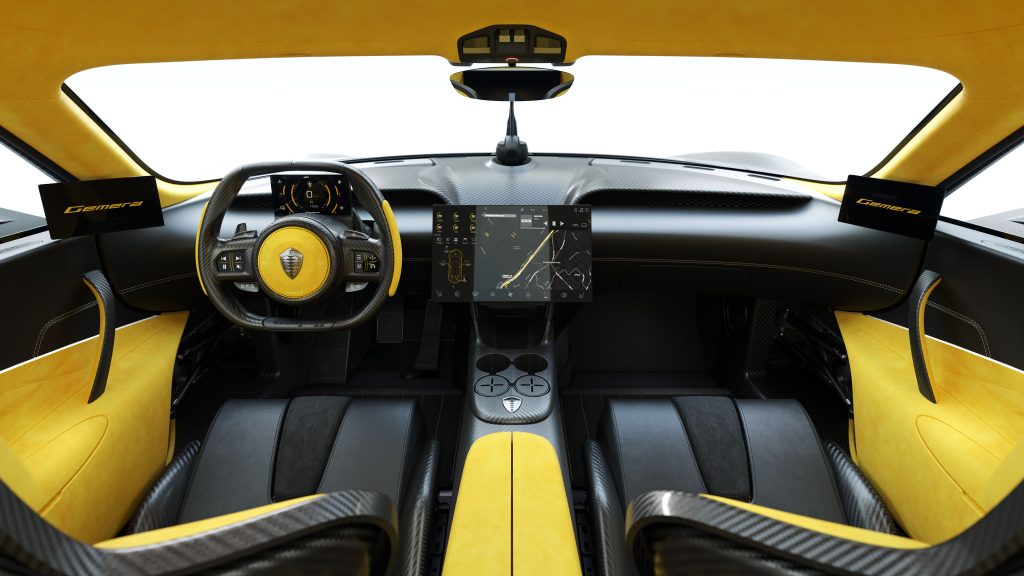
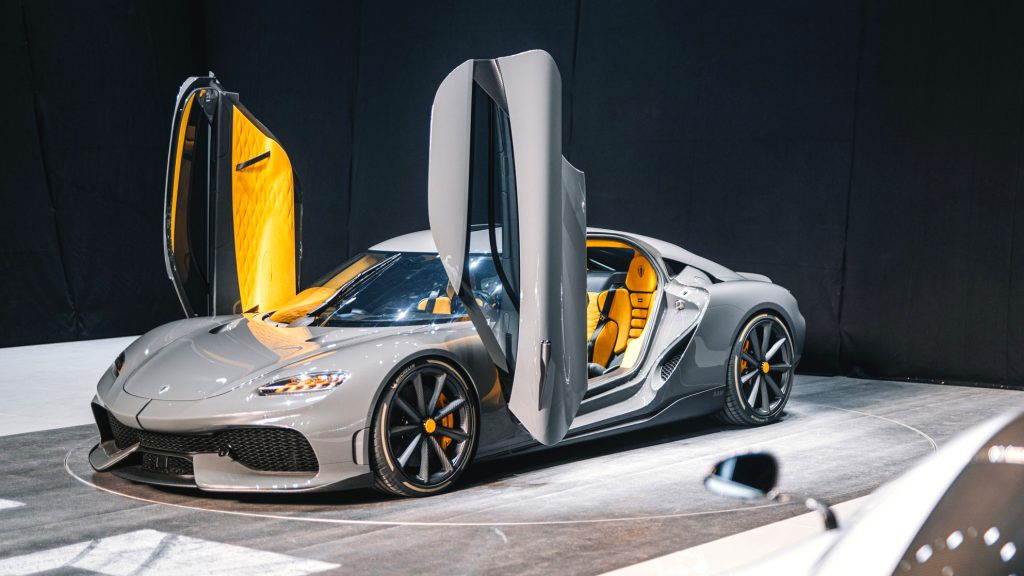
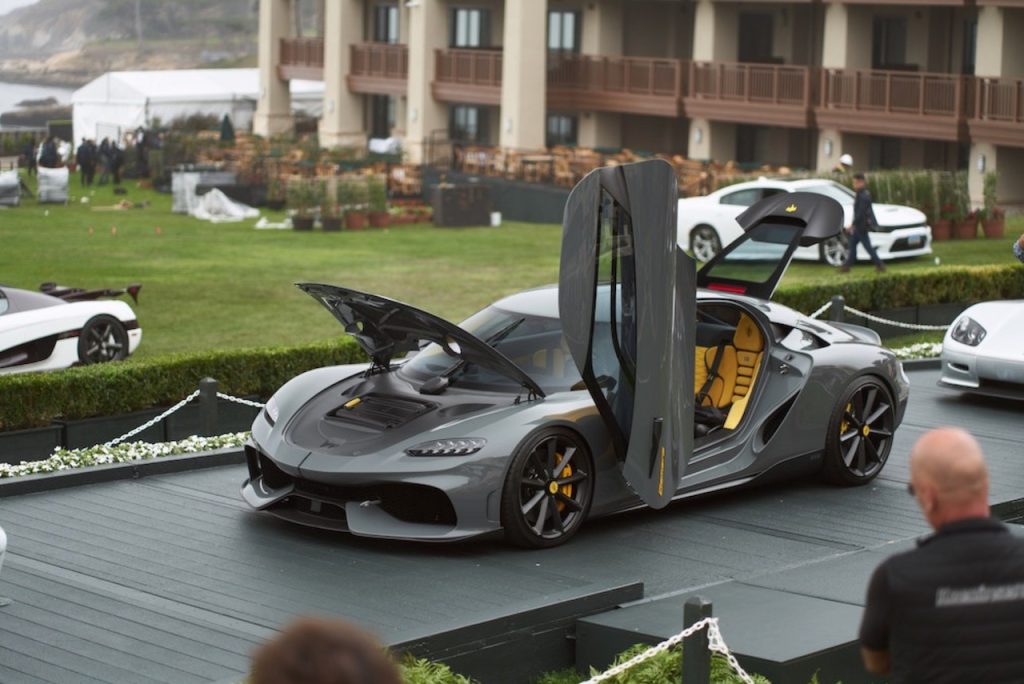
Aerodynamic innovation plays a crucial role in the Gemera’s performance envelope, with active aerodynamic elements seamlessly integrated into its sleek bodywork. The car’s shape evolves from Koenigsegg’s signature design language, featuring dihedral synchro-helix doors that have become a hallmark of the brand, while incorporating new aerodynamic solutions tailored to the Mega-GT concept. Underbody aerodynamics work in concert with active rear spoilers and front air intakes to manage airflow for optimal downforce and cooling requirements. The absence of traditional side mirrors, replaced by digital cameras that feed displays mounted on the A-pillars, not only reduces drag but also enhances forward visibility – a thoughtful touch that exemplifies the car’s fusion of form and function. These aerodynamic considerations ensure stability at the Gemera’s top speed of 400 km/h while maintaining cooling efficiency for both the combustion engine and electric powertrain components during sustained high-performance driving.
The Gemera’s braking system represents another area of technical innovation, combining carbon ceramic brakes with regenerative braking capabilities from its electric motors. This hybrid braking system not only provides immense stopping power but also contributes to energy recovery, channeling kinetic energy back into the battery during deceleration. The brake-by-wire system integrates seamlessly with the vehicle’s stability control and torque vectoring systems, allowing for precise modulation of braking force at individual wheels to enhance cornering stability and reduce stopping distances. This integration of traditional friction brakes with advanced regenerative systems creates a braking experience that feels both familiar and futuristic, providing consistent pedal feel while maximizing energy efficiency.
Koenigsegg’s approach to sustainability in the Gemera extends beyond its hybrid powertrain and renewable fuel compatibility. The company has implemented eco-conscious manufacturing processes, utilizing recycled carbon fiber where possible and employing sustainable materials in interior trim components. The leather used in the cabin comes from ethically sourced suppliers, while alternative materials like recycled polyester and bio-based composites feature prominently in non-structural components. This environmental mindfulness extends to the production facility itself, which operates on renewable energy sources, reflecting a comprehensive approach to sustainable manufacturing that aligns with the evolving expectations of luxury consumers and environmental regulations.
The Gemera’s technological tour de force continues with its advanced connectivity and driver assistance features, areas where hypercars have traditionally lagged behind mainstream vehicles. A state-of-the-art infotainment system with over-the-air update capability ensures the car remains current with the latest software improvements, while a suite of driver assistance systems including adaptive cruise control, lane-keeping assist, and automated emergency braking bring hypercar performance into the realm of modern automotive safety standards. These systems are carefully calibrated to enhance rather than interfere with the driving experience, maintaining the Gemera’s focus on driver engagement while providing an additional layer of safety during everyday use.
In the context of automotive history, the Gemera represents a significant milestone in the evolution of high-performance vehicles, serving as a technological showcase that may influence future developments across the industry. Its elimination of traditional differential components through advanced electric torque vectoring demonstrates how electrification can enable new engineering solutions that improve both performance and packaging efficiency. The Mega-GT concept challenges traditional vehicle classifications, proving that extreme performance need not come at the expense of practicality or environmental responsibility. As automotive manufacturers worldwide grapple with the transition to electrification, the Gemera stands as a compelling example of how innovative thinking can reconcile seemingly contradictory objectives – creating a vehicle that is simultaneously faster, more efficient, and more versatile than its predecessors.
Koenigsegg’s relentless pursuit of innovation, evident in every aspect of the Gemera’s design and engineering, reaffirms the company’s position as a leader in automotive technological development. From its differential-less drivetrain to its hybrid combustion-electric powertrain and sustainable manufacturing practices, the Gemera pushes multiple boundaries simultaneously. It serves not only as a halo product for the brand but also as a testbed for technologies that may trickle down to more accessible vehicles in the future. In creating the world’s first Mega-GT, Koenigsegg has redefined what a hypercar can be – a vehicle that excites on track, cossets on long journeys, and conscientiously addresses the environmental challenges of high-performance motoring. The Gemera’s legacy may ultimately lie in its ability to inspire a new generation of vehicles that refuse to compromise between performance, practicality, and planetary responsibility, marking a new chapter in the ongoing evolution of the automobile.