 Zakirin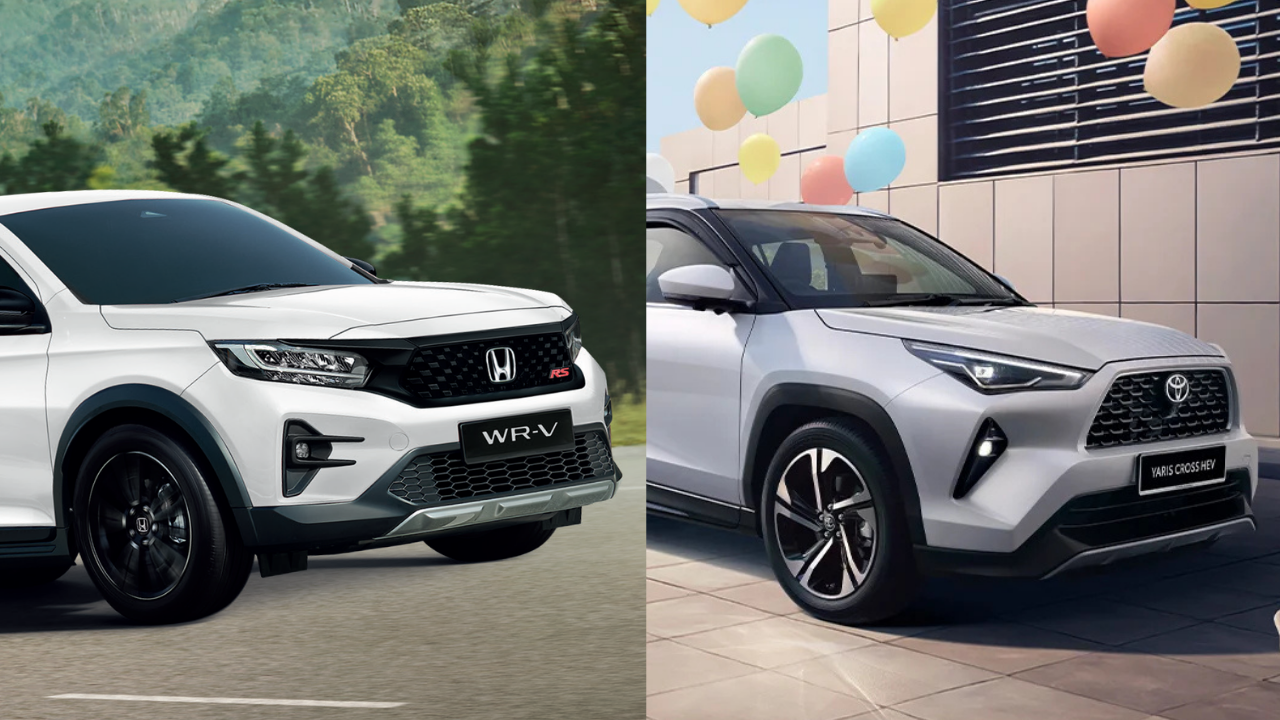
The Honda WR-V (RM 89,900 to RM 107,900) is a nimble, urban-focused crossover powered by a punchy 1.5-litre naturally aspirated 4-cylinder DOHC i-VTEC engine (121 PS / 145 Nm) paired with a CVT, featuring 207 mm ground clearance, a 380-litre boot, and available Honda SENSING with Honda LaneWatch. The Toyota Yaris Cross (RM 99,900 to RM 109,900) is built on the DNGA-B platform in a larger B-segment footprint (4,310 mm length), offering a choice between a 1.5-litre petrol engine (106 PS / 138 Nm) or an ultra-frugal 1.5-litre Self-Charging Hybrid (HEV) returning up to 33.3 km/L (~3.0 L/100 km), backed by a massive 471-litre boot, standard Electronic Parking Brake (EPB), and full Toyota Safety Sense (TSS).
Quick Verdict:
- Choose the Honda WR-V if:You want stronger naturally aspirated top-end power (121 PS / 145 Nm), a more compact 4,060 mm body for effortless tight parking, a lower starting price (from RM 89,900), and the Honda LaneWatch live blind-spot camera system.
- Choose the Toyota Yaris Cross if:You want a larger B-segment crossover with a longer 2,620 mm wheelbase, ultra-low hybrid fuel consumption (up to 33.3 km/L), a cavernous 471-litre boot, an Electronic Parking Brake with Auto Hold, an 8-way power driver’s seat, and a 10.1-inch screen with Wireless Apple CarPlay & Android Auto.
💰 Estimated Monthly Ownership Breakdown
| Cost & Ownership Factor | Honda WR-V (1.5 S / E / V / RS) | Toyota Yaris Cross (1.5S Petrol / 1.5S HEV Hybrid) |
| Price (OTR w/o Insurance, Peninsular) | RM 89,900 (S) – RM 107,900 (RS) | RM 99,900 (1.5S Petrol) – RM 109,900 (1.5S HEV) |
| Standard Manufacturer Warranty | 5 Years / Unlimited Mileage | 5 Years / Unlimited Mileage (+8-Yr Hybrid Battery/ECU) |
| Estimated 5-Year Maintenance Cost | ~RM 3,300 – RM 3,900 (Honda Scheduled Service) | ~RM 3,200 – RM 3,800 (Toyota MaxCheck Schedule) |
| Annual Road Tax (Peninsular MY) | RM 90 (1,498 cc) | RM 90 – RM 120 (1,496 cc) |
| Claimed Fuel Consumption | ~6.0 L/100 km (~16.7 km/L) | ~6.1 L/100 km (Petrol) / ~3.0 – 3.6 L/100 km (HEV: up to 33.3 km/L) |
| Luggage Space (Boot Capacity) | 380 Litres | 471 Litres (Petrol) / 465 Litres (HEV) |
| Est. Monthly Loan (9-Yr @ 3.0%–3.5%) | ~RM 950/mo (S) – ~RM 1,140/mo (RS) | ~RM 1,055/mo (Petrol) – ~RM 1,165/mo (HEV) |
📊 Comprehensive Specification Comparison
| Feature / Spec | Honda WR-V (1.5 RS / V) | Toyota Yaris Cross (1.5S Petrol / 1.5S HEV) |
| Segment / Body Style | 5-Seater A/B-Segment Compact Crossover | 5-Seater B-Segment Compact SUV |
| Underpinning Architecture | Honda Global Small Car Platform | Daihatsu New Global Architecture (DNGA-B) |
| Assembly | CKD (Local Assembly, Melaka, Malaysia) | CKD (Local Assembly, Bukit Raja, Malaysia) |
| Engine Type | 1.5L 4-Cylinder 16V DOHC i-VTEC (L15ZF) | 1.5L Dual VVT-i (2NR-VE) / 1.5L Atkinson-Cycle Hybrid |
| Displacement | 1,498 cc | 1,496 cc |
| Transmission Type | Continuous Variable Transmission (CVT) | Dual-Mode CVT (D-CVT) (Petrol) / e-CVT (HEV) |
| Drivetrain Layout | Front-Wheel Drive (FWD) | Front-Wheel Drive (FWD) |
| Max Power Output | 121 PS (119 hp / 89 kW) @ 6,600 RPM | 106 PS (Petrol) / 111 PS Combined (91 PS Eng + 80 PS Motor HEV) |
| Max Torque | 145 Nm @ 4,300 RPM | 138 Nm (Petrol) / 121 Nm Engine + 141 Nm Motor (HEV) |
| 0–100 km/h Acceleration | ~11.0 – 11.3 seconds | ~11.8 seconds (Petrol) / ~10.2 seconds (HEV) |
| Top Speed | ~175 km/h | ~170 km/h |
| Fuel Tank Capacity | 35 Litres | 42 Litres (Petrol) / 36 Litres (HEV) |
| Dimensions (L x W x H) | 4,060 mm x 1,780 mm x 1,608 mm | 4,310 mm x 1,770 mm x 1,615 mm |
| Wheelbase | 2,485 mm | 2,620 mm (+135 mm longer) |
| Ground Clearance | 207 mm | 210 mm |
| Kerb Weight | 1,110 – 1,145 kg | 1,175 kg (Petrol) / 1,285 kg (HEV) |
| Turning Radius | 5.2 metres | 5.2 metres |
| Boot Space | 380 Litres | 471 Litres (Petrol) / 465 Litres (HEV) |
| Wheels & Tyres | 16-inch (S/E) / 17-inch Alloys (215/55 R17 on V/RS) | 18-inch Two-Tone Alloys (215/55 R18) |
| Parking Brake | Traditional Mechanical Handbrake Lever | Electronic Parking Brake (EPB) with Auto Brake Hold |
| Hands-Free Tailgate | Not Available | Power Tailgate with Kick Sensor |
| Driver Seat Adjustment | 6-Way Manual Adjustable Seat | 8-Way Power-Adjustable Driver Seat |
| Infotainment Screen | 7.0-inch Touchscreen (Wired CarPlay & Android Auto) | 10.1-inch Touchscreen (Wireless CarPlay & Android Auto) |
| Driver Instrument Cluster | 4.2-inch TFT MID with Analogue Dials | 7.0-inch Full TFT Multi-Info Digital Cluster |
| Blind Spot System | Honda LaneWatch Camera System (V & RS) | Blind Spot Monitor (BSM) & Rear Cross-Traffic Alert (RCTA) |
| Parking Camera | Multi-Angle Reverse Camera | 3D Panoramic View Monitor (360° PVM) |
| Airbags | 4 Airbags (S & E) / 6 Airbags (V & RS) | 6 SRS Airbags (Standard on both trims) |
| ADAS Safety Suite | Honda SENSING (E, V, RS trims) | Full Toyota Safety Sense (TSS Level 2 Standard) |
⚡ Key Differences Breakdown
🚗 Powertrain, Hybrid Efficiency & Driving Dynamics
- Honda WR-V: Uses a single powertrain across all variants: a 1.5-litre naturally aspirated 4-cylinder DOHC i-VTEC engine producing 121 PS and 145 Nm of torque paired with a step-logic CVT. It delivers higher top-end horsepower and punchier highway passing power above 100 km/h, though fuel economy is standard for its class (~6.0 L/100 km).
- Toyota Yaris Cross: Offers two powertrain choices. The standard 1.5S Petrol uses a 1.5-litre Dual VVT-i engine (106 PS / 138 Nm) with a D-CVT. The standout 1.5S HEV Hybrid combines an Atkinson-cycle engine with an electric motor to deliver instantaneous low-end electric torque (141 Nm motor) and exceptional fuel efficiency rated between 27.8 km/L and 33.3 km/L (approx. 3.0 to 3.6 L/100 km), easily doubling the WR-V’s city fuel efficiency.
🎨 Dimensions, Ground Clearance & Boot Practicality
- Honda WR-V: Adopts a compact, stubby crossover silhouette measuring 4,060 mm long with a 2,485 mm wheelbase. Its smaller footprint makes it noticeably easier to slot into narrow city parking spaces and tight U-turns. Ground clearance is high at 207 mm, and boot capacity is generous for its short length at 380 Litres.
- Toyota Yaris Cross: Sits in a true B-segment footprint at 4,310 mm long (+250 mm longer than the WR-V) with a 2,620 mm wheelbase (+135 mm). This gives rear passengers substantially more knee room and legroom. Its boot capacity is class-leading at 471 Litres (465L on the hybrid), featuring a 200 mm deep underfloor storage compartment and a hands-free power tailgate with a kick sensor.
🛋️ Cockpit Tech, Infotainment & Safety Architecture
- Honda WR-V: Features a 7.0-inch touchscreen with wired Apple CarPlay/Android Auto, analogue gauges with a 4.2-inch MID, a traditional mechanical handbrake lever, and Honda LaneWatch on V and RS trims (a passenger-side blind-spot camera). Honda SENSING Level 2 ADAS is included from the E trim upwards, but the base S trim is limited to 4 airbags and lacks active safety.
- Toyota Yaris Cross: Comes far better equipped out of the box with standard Electronic Parking Brake (EPB) with Auto Hold, an 8-way power driver’s seat, a 7.0-inch digital instrument cluster, a 10.1-inch touchscreen with Wireless Apple CarPlay & Android Auto, Qi wireless charging, a 3D 360-degree panoramic camera, standard 6 airbags, and full Toyota Safety Sense (TSS) on every variant.
🌟 3 Things We Love
Honda WR-V
- Punchy 121 PS i-VTEC Engine: Stronger high-rpm horsepower makes high-speed highway overtaking and continuous uphill climbs feel more responsive than the 106 PS petrol Yaris Cross.
- Compact City Agility: The short 4,060 mm body allows effortless maneuvering through crowded urban streets, tight shop-lot alleys, and compact basement parking bays.
- Honda LaneWatch Camera: Projecting a live, high-resolution feed of the left-side blind spot onto the screen makes changing lanes across multi-lane highways stress-free.
Toyota Yaris Cross
- Ultra-Frugal 1.5S HEV Hybrid (Up to 33.3 km/L): The 4th-gen series-parallel hybrid delivers exceptional fuel economy, allowing over 900 km of driving range on a single 36-litre tank.
- Cavernous 471-Litre Boot & Power Kick-Tailgate: Massive luggage volume paired with a motorized kick-activated tailgate offers unmatched cargo utility in the sub-RM 110k Japanese crossover class.
- Loaded Tech (EPB, Power Seat & Wireless CarPlay): Standard Electronic Parking Brake with Auto Hold, 8-way power driver’s seat, and a 10.1-inch wireless touchscreen provide a noticeably more modern cabin.
⚠️ 2 Things That Need Work
Honda WR-V
- Dated Cabin Tech & Mechanical Handbrake: The small 7.0-inch infotainment display, analogue gauge cluster, and manual handbrake lever look and feel older compared to the Yaris Cross.
- Base S Variant Compromises: The entry-level RM 89,900 S variant is stripped down to just 4 airbags and omits Honda SENSING active safety.
Toyota Yaris Cross
- Modest NA Petrol Power (106 PS / 138 Nm): The non-hybrid 1.5S petrol model accelerates moderately (0–100 km/h in ~11.8s), lacking the top-end highway punch of Honda’s 121 PS i-VTEC engine.
- Firmer Low-Speed Ride on 18-Inch Wheels: Standard 18-inch wheels with 215/55 R18 tyres transmit sharper road ridges and expansion joints into the cabin at low city speeds.
🏁 Buying Conclusion
The Honda WR-V is the better choice for drivers who want a punchy, compact, and easy-to-park city crossover. Ranging from RM 89,900 to RM 107,900, it delivers the higher top-end output of Honda’s 121 PS i-VTEC engine, a tight 4,060 mm length for stress-free urban driving, 207 mm ground clearance, and the proven Honda LaneWatch camera system. If you prioritize higher petrol horsepower, compact dimensions for parking, and a lower initial purchase price, the WR-V RS remains an agile city companion.
The Toyota Yaris Cross is the superior all-round family crossover and modern tech package. Priced between RM 99,900 and RM 109,900, it gives you a larger B-segment body (+135 mm longer wheelbase), a class-leading 471-litre boot with a kick-sensor tailgate, standard Electronic Parking Brake with Auto Hold, an 8-way powered seat, and a 10.1-inch wireless touchscreen. Furthermore, the 1.5S HEV Hybrid variant at RM 109,900 delivers game-changing 33.3 km/L fuel efficiency that drastically reduces monthly petrol bills, making the Yaris Cross the more comprehensive, future-proof buy.