 Zakirin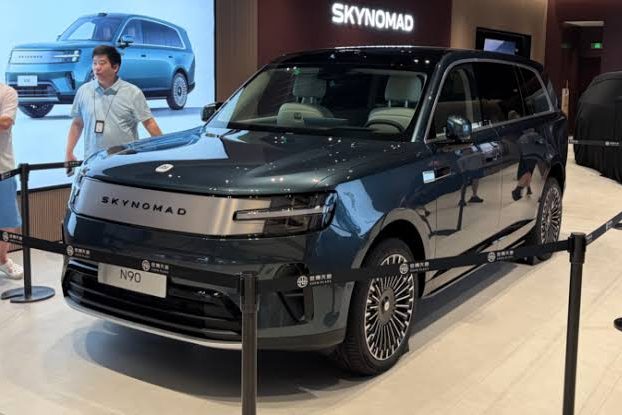
Everyone assumed Xiaomi’s third automotive act would be another sleek, low-slung electric vehicle with a focus on aerodynamics. Instead, the tech giant has surprised the market by revealing the SkyNomad, a massive, upright, and unapologetically boxy family SUV.
Crucially, the SkyNomad is not a pure EV. It is an extended-range electric vehicle (EREV), marking a significant departure from the fully electric SU7 and YU7.
Form Follows Function: The Boxy Brief
The SkyNomad’s squared-off shape is not merely a stylistic choice; it is the entire foundation of the vehicle’s design brief. Built on Xiaomi’s new proprietary Kunlun Technical Architecture, the SUV is designed to maximize interior volume, offering MPV-level space within an SUV footprint.
The lineup debuts with two primary configurations:
- SkyNomad N90 Max: A flagship 7-seater measuring a massive 5,285 mm long, 1,998 mm wide, and 1,825 mm tall, resting on a 3,080 mm wheelbase.
- SkyNomad N70 Max: A mid-to-large 5-seater measuring 4,960 mm long, 1,998 mm wide, and 1,765 mm tall, with a 2,950 mm wheelbase.
Despite its blunt, refrigerator-like proportions, Xiaomi managed to achieve a respectable drag coefficient of 0.255 Cd on the N90 Max through over 140 aerodynamic tweaks, including an active front grille. The exterior is modernized with recurring rounded-rectangle motifs, “dragonfly-shaped” headlights, an inverted U-shaped taillight, and smart electric doors that open up to 90 degrees with 360-degree AI anti-collision sensors.
The Headline Feature: A Completely Flat Floor
The engineering highlight of the SkyNomad is its reconfigurable, completely flat cabin floor.
By utilizing the Kunlun Platform’s highly integrated rear coaxial electric drive unit and repositioning the battery control modules, Xiaomi engineers successfully reduced the floor thickness by 180 mm. This completely eliminated any interior floor steps, creating an uninterrupted flat surface that extends across the second and third rows straight through to the cargo area.
This flat architecture allows for extra-long sliding seat rails—up to 1,938 mm on the N90 Max—allowing the cabin to be heavily reconfigured for passenger comfort or maximum cargo space.
EREV Powertrain and Efficiency
Moving away from pure electric drive, the SkyNomad is powered by the Xiaomi Kunlun HyperRange EREV system. It utilizes a 1.5-litre turbocharged petrol engine (developed with Dongan Auto Engine) that produces 112 kW.
This combustion engine acts strictly as an onboard generator to charge the battery and never physically drives the wheels. Xiaomi claims the system is highly efficient, supporting standard 92-octane gasoline and achieving a depleted-battery fuel consumption figure of just 5.7 litres per 100 km under the WLTC testing cycle.
Pricing and Malaysian Availability
In China, pre-sale pricing for the SkyNomad opened on July 30, 2026. The 5-seat N70 Max starts at RMB 259,900 (roughly RM157,000 to RM160,000), while the flagship 7-seat N90 Max commands RMB 299,900 (roughly RM181,000 to RM185,000).
Is it coming to Malaysia?
Not anytime soon. Xiaomi currently does not sell cars in Malaysia. The company has stated that its global automotive expansion is slated to begin in 2027, with right-hand-drive markets specifically targeted for the first half of 2028. While Xiaomi has recently advertised for automotive-related government relations roles in Malaysia, local buyers will simply have to wait.