 Akmal Azhar
Record-Breaking 0–200mph Time
The Lotus Evija has rewritten the history books. In Autocar’s most recent definitive road test—published in the 30 July 2025 issue—the £2 million, 2013 bhp electric hypercar shattered multiple acceleration benchmarks, most dramatically its 0–200 mph time, achieved in just 13.0 seconds. That performance represents a staggering 40% improvement over Autocar’s previous best.
Fastest Car in Autocar’s Road Test History
First unveiled in 2019 and reaching customers in 2024, the Evija has emerged as the fastest car ever recorded by Autocar’s road-test programme, which dates back to 1928. It now holds the outright fastest times from standstill to 150 mph, 200 mph, and over both the quarter-mile and standing kilometre.
Unmatched High-Speed Acceleration

Autocar’s Road Test Editor, Matt Saunders, noted that while the Evija feels rapid through 60 mph and 100 mph, its true strength becomes apparent above those speeds. Propelled by four electric motors and increasing aerodynamic downforce, it demolishes benchmarks between 100–200 mph. From 100–150 mph, it is nearly three seconds quicker than any previously tested hypercar, and five seconds faster from 150–200 mph.
Standing Kilometre and Braking Performance

Only the third road‑legal production car tested by Autocar to reach 200 mph from rest, the Evija completed the standing kilometre at 217.4 mph. It reached that speed well before the end of the mile, giving plenty of margin for braking—a rare feat even among hypercars.
Quarter-Mile and Comparative Performance
In further impressive feats, the Evija ran a standing quarter-mile in 9.5 seconds at 171.6 mph, and the standing kilometre in just 16.2 seconds at 217.4 mph. By contrast, the Tesla Model S Plaid completed the quarter-mile in 9.6 seconds at 152.1 mph, and the Lamborghini Revuelto hit 186.6 mph over a kilometre in 17.7 seconds.
Dominating the Performance Leaderboard
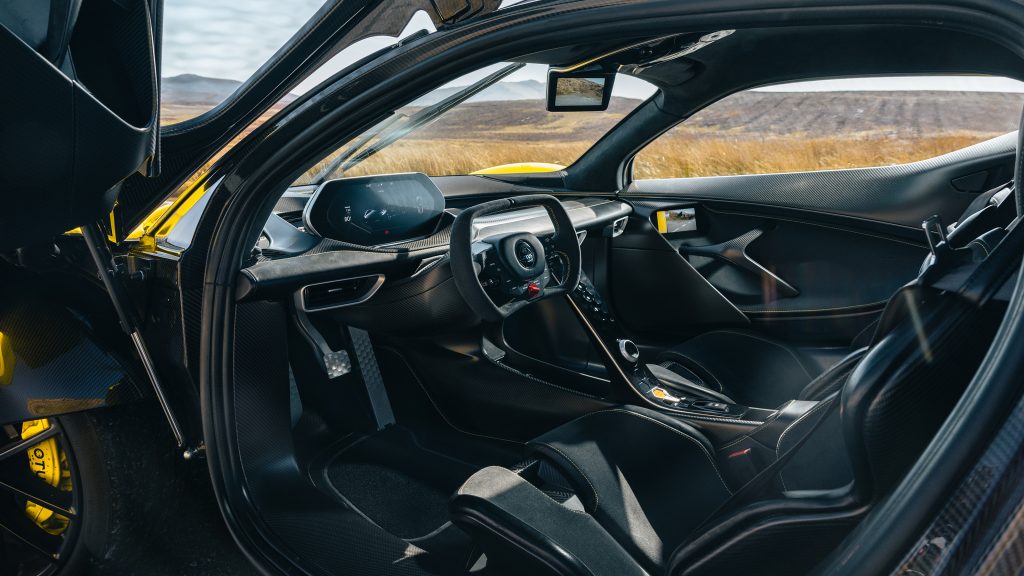
The Evija now sits at the top of Autocar’s all-time performance charts. Its 0–150 mph time of 7.7 seconds is significantly ahead of the Tesla Plaid’s 9.4 seconds and the Revuelto’s 10.0 seconds. Its 0–200 mph record of 13.0 seconds surpasses the Bugatti Veyron Super Sport’s 22.2 seconds and McLaren F1’s 28.0 seconds.
Lotus’s Unique Hypercar Philosophy

According to Saunders, Lotus opted not to chase the traditional goals of lap times or top speed. Instead, the company aimed to maximise electric propulsion’s core strength—unrelenting torque and instant response—specifically targeting acceleration benchmarks like 0–200 mph and the standing kilometre.
A New Benchmark for Electric Hypercars

This approach has paid off. The Evija didn’t just improve on records—it obliterated them. The leap made in 2025, compared to previous industry milestones, is proportionally twice the advancement seen when Bugatti surpassed McLaren’s benchmark in the early 2010s.
Conclusion
The Lotus Evija stands as a monument to what electric hypercars can achieve. It has earned its place not just among the fastest cars Autocar has ever tested, but as a defining machine in the history of performance vehicles.

 Zakirin